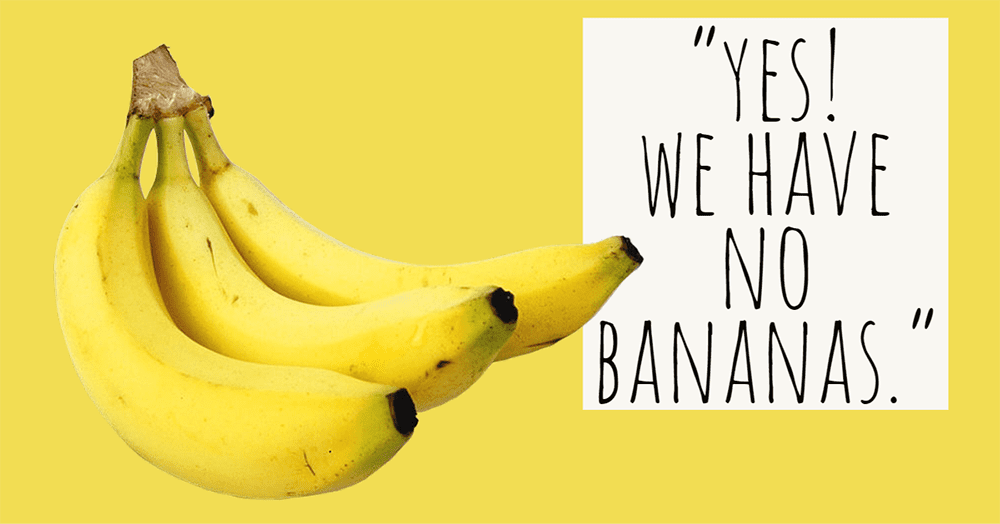
Do you ever get frustrated trying to get a straight answer out of a customer service representative? And if you’re using email or chat, it’s even tougher. Somewhere along the line, CSRs were taught to reframe a “no” in positive language. But sometimes a customer just wants to hear a straight no, if that is indeed the answer.
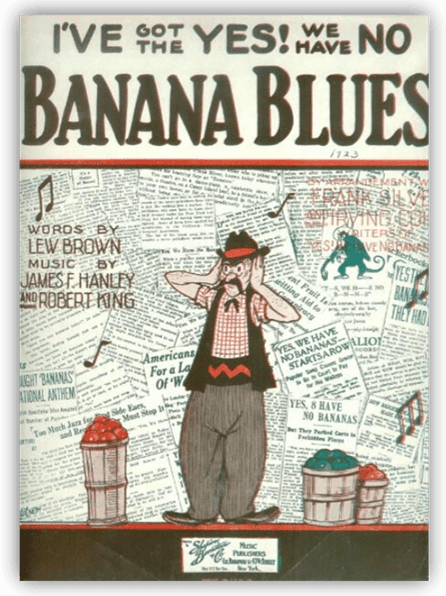
This positive-negative dance reminds me of that old novelty song, “Yes, We Have No Bananas.” Here’s the first verse and the chorus…
There’s a fruit store on our street
It’s run by a Greek.
And he keeps good things to eat
But you should hear him speak!
When you ask him anything, he never answers “no”.
He just “yes-es” you to death, and as he takes your dough
He tells you
“Yes, we have no bananas
We have-a no bananas today.
We’ve string beans, and onions
Cabbageses, and scallions,
And all sorts of fruit and say
We have an old fashioned to-mah-to
A Long Island po-tah-to
But yes, we have no bananas.
We have no bananas today.”
Is Storyworth worth the story? You decide…
My daughter bought both my husband and I subscriptions to Storyworth for Christmas 2023. Storyworth is a platform that sends subscribers one writing prompt a week to encourage them write down family stories. You can use the prompts they send or choose from others on the Storyworth website, make up your own, and even add photos.

Then, at the end of a year, storytellers organize their stories, select a cover, and the company prints them into a book. The $99 subscription includes a $39 credit toward printing a book with a color photo on the cover but black-and-white inside. To upgrade to a color interior is extra, as are multiple copies.
Being a writer, I really got into this project and produced 41 stories. I found the Storyworth interface clumsy and a bit limited (no text-wrap around photos, bold, italic or underlining, for example), but I’ve done a lot of desktop publishing and web design, so I adapted. My husband wasn’t as prolific as I was and wrote 16 stories, which I edited for him. All in all, I liked the experience of writing the stories and identifying new meaning in events of long ago. The process also got me working on my novel again and ultimately led me to start this blog. A few of the Storyworth stories I even adapted into blog posts.
As the year wound down and I prepared to order the books, I noticed on the Storyworth website you could ask to combine stories in multiple accounts into one book as long as the final product didn’t exceed a certain number of pages. My thinking was, since hubs had fewer stories, to combine our stories and use the extra $39 credit toward color printing. The online FAQ didn’t address this specifically, and when I emailed customer service I kept getting a “Yes, we have no bananas” response.
Storyworth yes-es me to death
Here’s a transcript…
- ME: My husband and I each were given Storyworth subscriptions for Christmas 2023 by our daughter and would like to combine our stories into just one book of 402 pages. Our names are Chris and Susan Lawson. I will want his stories printed first, then mine in the combined book. We would also like our $39 credits combined so we can get full color in the single book and only pay a few additional dollars. Is that how it works? I have previewed all the pages for both storytellers and corrected issues. Now how do I go about combining them and specifying cover details in the online ordering process? Your help facility says to contact you at this email for further instructions.
- STORYWORTH (DELIO O): Hello Susan! Thank you for reaching out! I’ve popped over into your account and added that combined book for you. You will see that at the bottom of your homepage. The first time you click on the combined book, you will be prompted to choose a new cover design and edit it. When you save the cover, on the next page, you will be able to review the interior of the combined book. Regarding the book credits, you can redeem them during the order process (checkout); you can use those credits to get $39 off a color book version. Please do not hesitate to reach out should you have any further questions or concerns.
- ME: Thank you for your help. However, I’m a bit confused about the credit. Since 2 Storyworth subscriptions were originally purchased, shouldn’t the combined book get $39 x 2, or $78, credit?
- STORYWORTH (DELIO O): Hello Susan! Welcome back! There isn’t an option to combine the credits just because their respective books were combined, and actually, there is no need for this as you can use both credit books at the same time (on the same order) to get a double discount on the total amount. I hope I was able to clarify that doubt, but feel free to ask if any point that is still not clear remains.
- ME: No, you only confused me more. At first you said I could not use both credits on one combined book. Then it sounded as if you said I could do so. I’m not angry–just very confused. Please clarify. Thank you.
- STORYWORTH (HEIDER R): Thank you for reaching us out with your query! I apologize beforehand about the confusion regarding the purchase of the combined book. Even though we are combining the stories (or books) from 2 or more storytellers into one combined version, the accounts are not merged and therefore, they will remain the same as before, with your stories and book volume intact. Based on this precept, book credits don’t get combined, each storyteller will order the combined book from their respective accounts, or you can ask the original purchaser of the subscription (in this case your daughter) to place the order since she’s the only one who can see both book credits from her account. I hope this clears the air! Please let us know if you have any additional questions.
- ME: So if my daughter orders the combined book from her account, can she use the credit to upgrade it to all color?
- STORYWORTH (HEIDER R): Thank you for reaching us out! Any of you can upgrade to color, not just the original purchaser of the subscription. You can certainly order a color book if you would like, but you will need to pay an upgrade charge, depending on the page count of your book. The cost of the upgrade is: <300 pages – $40 USD, >300 pages – $60 USD. Please do let us know if we can help with anything else moving forward, we are here to help.
Cry Uncle!
At this point, my ears were ringing and my head hurt, even though the entire conversation transpired through soundless emails. Loving language as I do, seeing it twisted out of sensible shape even brought on a wave of nausea.
So I gave up and simply asked the Storyworth rep to separate the stories I’d previously asked to be combined. I didn’t quite understand the answer to that request either, but we’ll see how it works out.
I figured printing two books in black and white would use up both credits my daughter paid for. Though I would have liked color inside, I decided it wasn’t worth the upcharge with a company that couldn’t give me a direct yes-or-no answer to a simple question. If, indeed, there was an upcharge; I’m still not sure.
So no bananas and no color. And no REALLY satisfied customer, just a supremely frustrated one.
Hitting a new low
The whole experience reminded me of a story my brother told about his days as a sales executive. He understood that it was more cost-efficient to keep existing customers happy rather than always be looking for new ones, though the owner of one company he worked for didn’t agree.
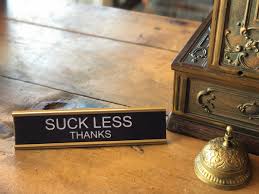
As VP of sales for that firm, my brother visited one of his bigger customers, who was decidedly unhappy, to try to resolve some of the issues. He asked his contact point-blank, “Why do you stay with us, since we are, admittedly, doing such a bad job?”
“Because you suck less than your competitors,” she replied.
Huh. What a great advertising slogan that would make: We suck LESS.
According to Forrester, a customer service research and consulting firm, customer experience in the United States declined in 2024 for the third year in a row. “U. S. consumers are having, on average, the worst experiences in a decade,” said Rick Parrish, Forrester VP and research director. “Brands want to create better experiences, and they realize that putting the customer at the center of their business is the way to do it. However, organizations struggle with the scale of change that this requires.”
Forrester describes only 3 percent of companies as being “customer-obsessed,” and even those lost ground in 2024. In addition to 39 percent of brands and 10 industry averages declining in quality over the past year, performance dropped across all three dimensions — effectiveness, ease and emotion. Forrester says emotion remains the key factor for delivering high levels of customer experience performance, and US brands struggle to connect emotionally with customers.
I wonder what that would look like–“connecting emotionally with customers”? I think it would look like what my brother did, confronting the situation head-on, listening and trying to make it right. Giving clear answers to questions would certainly make for a good start. And not using chatbots, which may have been what “Delio O” and “Heider R” really were.
After all, it IS okay to say no, you know

Even for chatbots.
In fact, according to Customer Think, an online global community of business leaders, saying no effectively has big benefits.
A convincing no that leaves a customer feeling treated fairly moves them from dissatisfied, where loyalty is less than 10 percent, to mollified, where loyalty is often 50 percent. An effective no to three customers generates as much revenue as winning one new customer. My brother had that part right.
Yes, mollified is how I would have felt if my question had been answered clearly in one email exchange instead of four-plus over the course of four days. After all, I was only trying to identify the policy, not get special treatment.
Had I got my answer, I might have continued to recommend Storyworth. I might even have concluded Storyworth sucks less than I feel it does now. Instead I wrote this post, and the most I can say is Storyworth sucks more than I thought at the beginning of my subscription.
You might also enjoy…
- A related post on A Meaningful Encounter: Connecting Over Culture & History at Check-in.
- The original version of the full “Yes! We Have No Bananas” novelty song from 1923. Click on the arrow to listen:
- A more recent and slightly different version of “Yes! We Have No Bananas” from the novelty song king, Louie Prima:
Had a less than stellar customer service experience? Do tell! That’s what comments are for…
You might also enjoy…






 & {sometimes} WHY
Leave a reply to Susan Clark Lawson Cancel reply