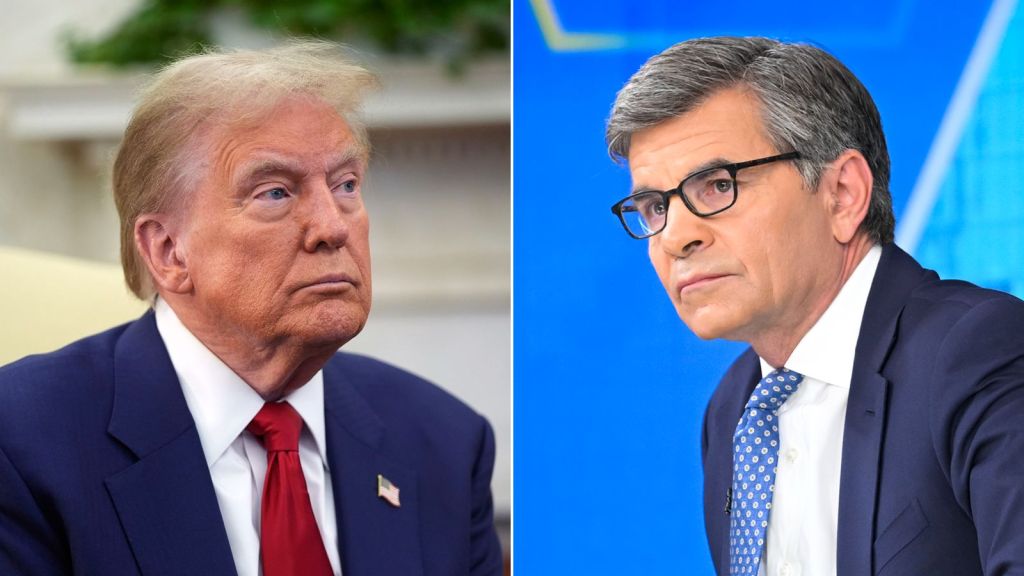
I know how ABC News Anchor George Stephanopoulos must feel. I, too, was sued for defamation then abandoned by my employer. Neither he nor I got fired (in fact, his contract with ABC was subsequently renewed) because neither of us did anything wrong. We just got hung out to dry, as did my newspaper’s readers and ABC viewers.
Frankly, ALL Americans got hung out to dry on this latest one. Thus the “Bosses Not at Their Best” in this post are the big conglomerates who own media properties.

ABC, a Disney owned subsidiary, announced Dec. 14 it would pay $16 million to settle a defamation suit brought by Donald Trump because Stephanopolous said in an interview last March Trump had been “liable for rape” in the E. Jean Carroll civil case. Technically, Trump was found liable for sexual assault, since in New York state at the time of the assault, only a penis forcibly inserted into a vagina, rather than the Don’s fingers, constituted rape.
The finding that Ms. Carroll failed to prove that she was ‘raped’ within the meaning of the New York Penal Law does not mean that she failed to prove that Mr. Trump ‘raped’ her as many people commonly understand the word ‘rape.’ Indeed, as the evidence at trial recounted…makes clear, the jury found that Mr. Trump in fact did exactly that.
In a July article published in the Washington Post, Trial Judge Lewis Kaplan clarified that forced digital penetration meets a more common definition of rape, citing definitions offered by the American Psychological Association and the United States Justice Department, which in 2012 expanded its definition of rape to include penetration “with any body part or object.” It also meets New York state law’s CURRENT definition of rape.
So why did ABC cave?
The press has been beside itself, speculating on the answer to that very question ever since the settlement was announced in mid-December. Before I get into what happened, let’s take a brief refresher look at the basics of defamation law.
WHAT CONSTITUTES DEFAMATION?
Defamation is a false statement that harms the reputation of a person, business or organization. Written or broadcast defamation is libel and considered more permanent, while spoken defamation is slander and is considered more fleeting.
To prove defamation, a plaintiff must show:
- The defendant made a false statement
- The statement was published or communicated to a third person
- At least one other person identified the plaintiff as the subject of the statement
- The statement caused damage to the plaintiff’s reputation
BUT NOT ALL PLAINTIFFS ARE CREATED EQUAL
The level of fault required to prove defamation depends on the status of the plaintiff:
- Non-public figures: The plaintiff must show the defendant acted with negligence.
- Public figures: The plaintiff must show the defendant acted with actual malice, defined as reckless disregard for the truth, which is considerably harder to prove than negligence. Public figures include those whose behavior, position or job puts them in the limelight, whether intentionally or not. A few examples are public officials, politicians and celebrities. Donald Trump, it’s interesting to note, is, has been, or will be all three.
ON TO THE DAMAGE QUESTION
In the ABC News case, Trump asked for a jury trial and unspecified punitive damages, court costs and other relief the court “deems just and proper.” This seems odd to me because, first off, no one gets ANY punitive damages unless they first prove ACTUAL damages, like loss of a job or business. Punitive damages are then awarded at the court’s–or a jury’s–discretion as an additional slap on the wrist to an adjudicated guilty defendant.
A good example is a defamation case Trump only recently lost: that brought by E. Jean Carroll, whose win in the civil suit she brought against him is at the heart of the ABC News case. She lost her job because of his trash talk about her on social media. THAT is actual loss and made her eligible for punitive damages, which the judge increased as Trump continued to defame her.
Trump couldn’t possibly prove any actual damage in the ABC case. So why not drop the suit? Because he wants to punish the media he’s labeled as biased. This is how he’s funded his campaigns and his lifestyle.
AN UNSETTLING SETTLEMENT
Neither a court nor a jury would likely ever award him any actual damages, and that’s why Disney’s settlement doesn’t pay him any directly. What he gets is a clarification tacked onto the end of the transcript of the interview in question, a $15 million “donation” to his future presidential library, and payment of his attorney fees in the amount of $1 million.
I’ll grudgingly give him the clarification; one is usually forthcoming in the circumstances. But since he brought a frivolous suit, it’s my opinion he’s entitled to nothing else. Nada, zero, zilch. The “gift” seems to me like a bribe from the Mouse House to keep their broadcast license from being revoked once Trump takes office–something easier said than done, yet its emissaries have already been visiting Mar-a-Lago, puckering up to kiss Don’s behind.
All I can say is, I hope Disney exec Don Iger wears a hazmat suit because there are unsubstantiated claims the president-elect has incontinence issues related to long-term drug use.
If that’s really the case, I hope Iger forgets the protective gear. He deserves whatever spews his way, a “gift” from one deserving Don to another.
Was George wrong in saying ‘rape’ repeatedly?
Stephanopoulos’ press fellows have speculated that Disney backpedaled on fighting the suit just before the case went into discovery because they must have thought malice could be proven. After all, the defamation was repeated several times during the interview in question.
More recently, The New York Post (not a particularly reputable publication, IMO) reported that the network’s executive producer repeatedly told Stephanopoulos beforehand not to say rape (according to anonymous workers on the set), but he said it anyway.
But even if it is true, I wouldn’t call that reckless disregard for the truth. I would ask, whose truth? The American Psychological Assocation calls it rape, the U. S. Justice Department calls it rape, and even New York state now calls it rape, and now is when the case was adjudicated. Other publications in reporting on the ABC case have also called it rape.
Maybe Stephanopoulos thought it was finally time someone called it what it was on air and slapped the appropriate label onto a most inappropriate candidate for the office of President of the United States. Maybe he thought it was striking a blow for women. After all, we don’t have as many choices these days, thanks to Trump, so maybe George thought to give us a bigger voice. Every WOMAN knows it’s rape if ANYTHING is inserted into her vagina against her will.
My small-potatoes libel comparison
I was a reporter for a daily paper in a city of about 27,000, where a local law firm was harassing local government with a class-action lawsuit and a flurry of related nuisance motions. They claimed a city utility had overcharged customers and established a class to represent them, whether the customers wanted it or not, which set the law firm up to collect legal fees in a settlement or favorable court decision. The more motions they filed, the more money they would ultimately make.
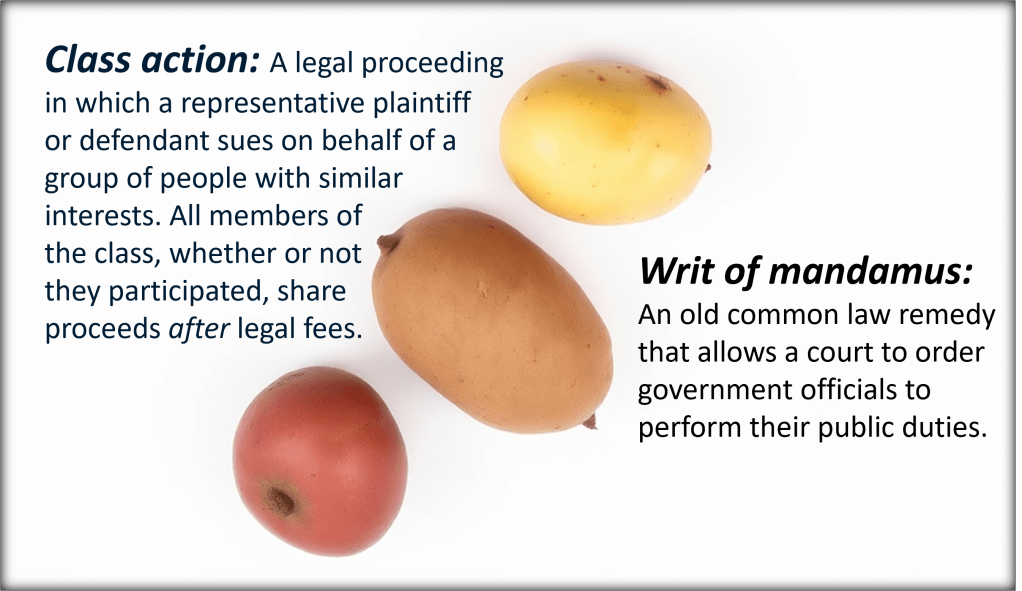
My alleged libelous article was written after I’d been on the job for less than six weeks, and it reported on the filing of yet another nuisance action. This time it was a “writ of mandamus” by an attorney for the same firm but acting, as the filing said, as a “taxpayer” and “customer.” Plaintiff alleged he had “good cause to believe” the city finance director was not complying with two city ordinances concerning the naming and use of funds in regard to that utility.
According to applicable state law then, persons filing mandamus actions stood to gain “reasonable” compensation for their efforts, and this was reported in the same article covering the filing, along with the city’s response regarding efforts it was making to comply and the city manager’s assertion that “actions like these [the mandamus writ] are really a hindrance in correcting…problems.”
The upshot was that the lawyer in question sued me, the managing editor and the newspaper itself for libel, claiming my article strung together unrelated information to imply his law firm was only in it for the money. But there was nothing in the article that wasn’t factual, so how was it libelous?
It wasn’t. The suit was meant to intimidate the newspaper, and it worked. Just like Trump’s suit against ABC News was meant to intimidate, and IT worked. Neither Thomsons Newspapers (my newspaper’s parent company) nor ABC’s parent Disney even bothered to request the case be dismissed, a standard first step. They simply caved.
In the dark
At the time, no one at the paper I worked for discussed the libel suit with me except to tell me not to talk about it. Like everyone else in town, I learned about its settlement when I read the newspaper’s apology–a small blurb buried on an inside page. I was sad. I didn’t get fired or even reprimanded, but I was disappointed I didn’t work for a braver paper. And I always wondered what really went on behind closed doors.
Sometimes we do eventually find out why. Or we can find out if we try.
After a reunion lunch with some of my newspaper coworkers in October, I decided to try to locate the man who was general manager at the time. An Internet search found him still writing opinion columns for some online local newspapers in eastern Pennsylvania. I emailed him, told him I never thought my article had a whiff of libel in it, and since no one had included me in any discussions or decisions, I would appreciate knowing what really transpired. His reply confirmed what I thought all along.
[The suit] was totally without merit…There was no libel in your story…They filed the suit simply as intimidation. Their claims were shaky and the last thing they wanted was exposure…Thomson hired a lawyer who came to the paper and my initial impression was that the suit was going to be fought. I was shocked when Thomson…told me they were settling for chump change, something like $2,500, and an apology. I was furious. I could not convince corporate that we were totally in the clear and that if we caved our journalistic integrity would be seriously, maybe fatally, damaged in the community. I obviously lost that argument. Their position was that it would cost far more to fight them and for some reason they just could not see my point about our reputation.
ABC and its Disney bosses missed the point, too. That’s what happens when big corporations own media properties.
Back to Don & George, the media & the courts
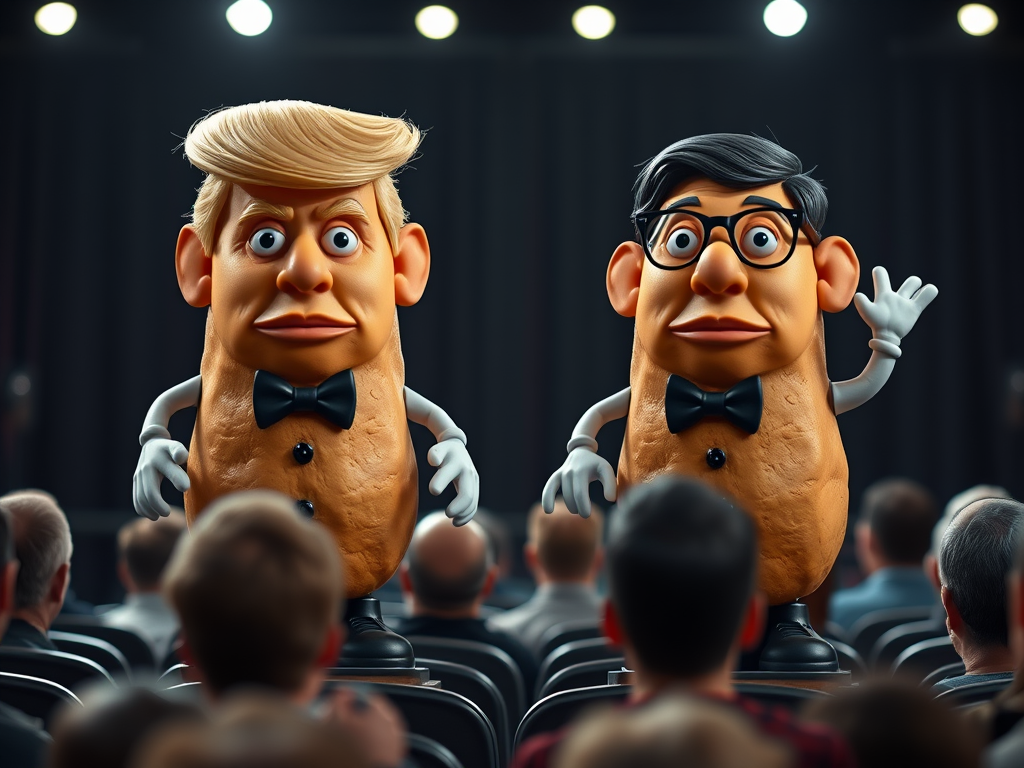
Trump and Stephanopoulos represent bigger “potatoes” and play on a bigger stage, so there’s more at stake with the settlement in this case than there was in mine.
The law makes it difficult for people like you and I to sue public officials for defamation because they can’t always be putting out fires or they’ll get nothing done (they have a tough enough time with that as it is, LOL). The law balances that privilege afforded public officials by providing extra protections for the people whose job it is to cover and critique public officials and public figures as a service to the public at large. Hence the requirement that public figures must prove malice.
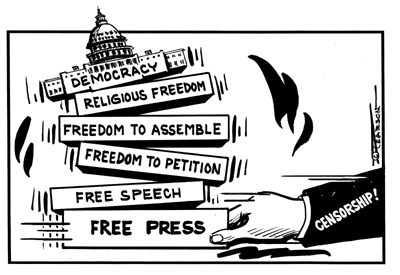
The media–good and bad– protect freedom of speech for us all by encouraging robust public discourse about public figures as well as critical commentary. Should they tell the truth? Absolutely, if they can sort it out. But their ethical duty is to present the FACTS, without bias.
Truth can be a moving target. These days, it seems to be what each individual WANTS to hear. And “The Truth” seems to be inching toward what Donald Trump wants to hear. Or maybe only what Donald Trump wants US to hear. And that’s where everything falls apart–free speech, our constitution, our democracy, our way of life.
Trump’s strategy of wearing down the press through nuisance lawsuits is bad for public discourse and bad for our democracy. News outlets caving to such suits to avoid expense and bad judgments is a sad commentary.
A dwindling marketplace of ideas
In Abrams v. United States, a 1919 Supreme Court case, Justice Oliver Wendell Holmes wrote in a dissenting opinion that has become a bastion of First Amendment thinking, “The ultimate good desired is better reached by free trade in ideas…the best test of truth is the power of the thought to get itself accepted in the competition of the market.”
The only problem is that competition is dwindling, and nuisance lawsuits like Trump’s are contributing to that.
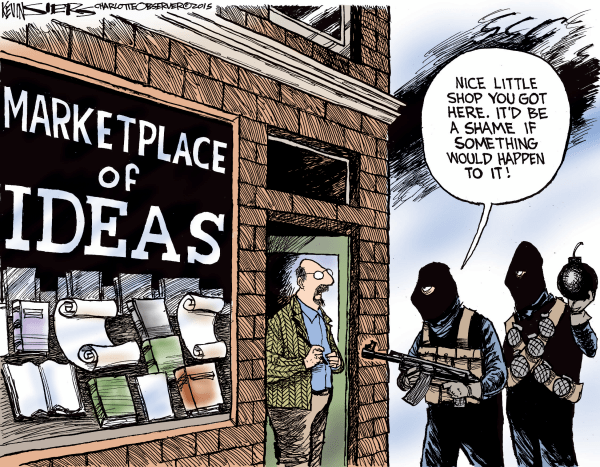
In the past, the courts have helped monitor and protect the marketplace of ideas. In the case of the class action lawsuit the city I worked in was burdened with, after many years of back-and-forth motions, a trial court found in favor of the law firm. But before lawyers could get their chops into the dictated settlement, the state supreme court overturned the decision in favor of the city.
Though justice eventually prevailed, city officials spent YEARS fighting the lawsuit. The daily newspaper eventually folded, and today that city’s government receives little coverage in a countywide online daily headquartered in a neighboring town.
The same thing is happening all across the United States. More than half of U. S. counties have limited or no access to local news. More than 1,500 counties have only one local news outlet–usually a weekly newspaper–and more than 200 counties are without ANY source of local news. According to Northwestern University’s Medill School of Journalism, the nation lost nearly 2,900 newspapers 2005-2023. An average 2.5 newspapers close each week. All this translates to the loss of 43,000 journalists.
What’s next?
A December 2024 survey conducted by the Washington Post and the University of Maryland says clearly that the majority of Americans disagree with Trump notions that threaten democratic norms, such as using the military to carry out mass deportations, pardoning all the Jan. 6 offenders, and police using force to stop anti-Trump protests. A full 88 percent said it would be wrong to jail reporters for writing articles Trump didn’t like.
So why did these people vote for Trump anyway? They’re depending, they say, on Congress and the courts to keep him in check.
Congress and the courts have their work cut out for them.
Too bad the courts never got a chance to have their say now and then on George’s and my defamation charges, respectively. I feel we both would have been exonerated. But the credibility of our courts is in flux. Trump seems to be coming for them next. When powerful individuals use frivolous lawsuits to stamp out dissent and first the news conglomerates buckle under, then the courts roll over and play dead, what’s left for you and I?
The outlook is grim indeed.
You might also enjoy…
Read these and weep*…
- The End of News, Dec. 23, 2024, The Atlantic
- Trump Signals Plans to Use All Levers of Power Against the Media, Dec. 22, 2024, Washington Post
- Majority of Americans Oppose Trump’s Proposals to Test Democracy’s Limits, Dec. 18, 2024, Washington Post
- Trump Has Found the Media’s Biggest Vulnerability, Dec. 18, 2024, The Atlantic
- The Mainstream Media Has Already Lost, Dec. 5, 2024, The Atlantic
- Why Trump Won’t Stop Suing the Media and Losing, March 23, 2024, The Atlantic
- The Media Are Getting Easier to Push Around, March 10, 2024, The Atlantic
- Judge Clarifies Yes, Trump Was Found to Have Raped E. Jean Carroll, July 19, 2023, Washington Post
*If you do not subscribe to these publications, you generally can view a few articles a month by registering. Some publications also have 30-day free trials.




 & {sometimes} WHY
Leave a reply to Rejecting Pardon: Pam Hemphill’s Stand Against Rewrite of History – & {sometimes} WHY Cancel reply