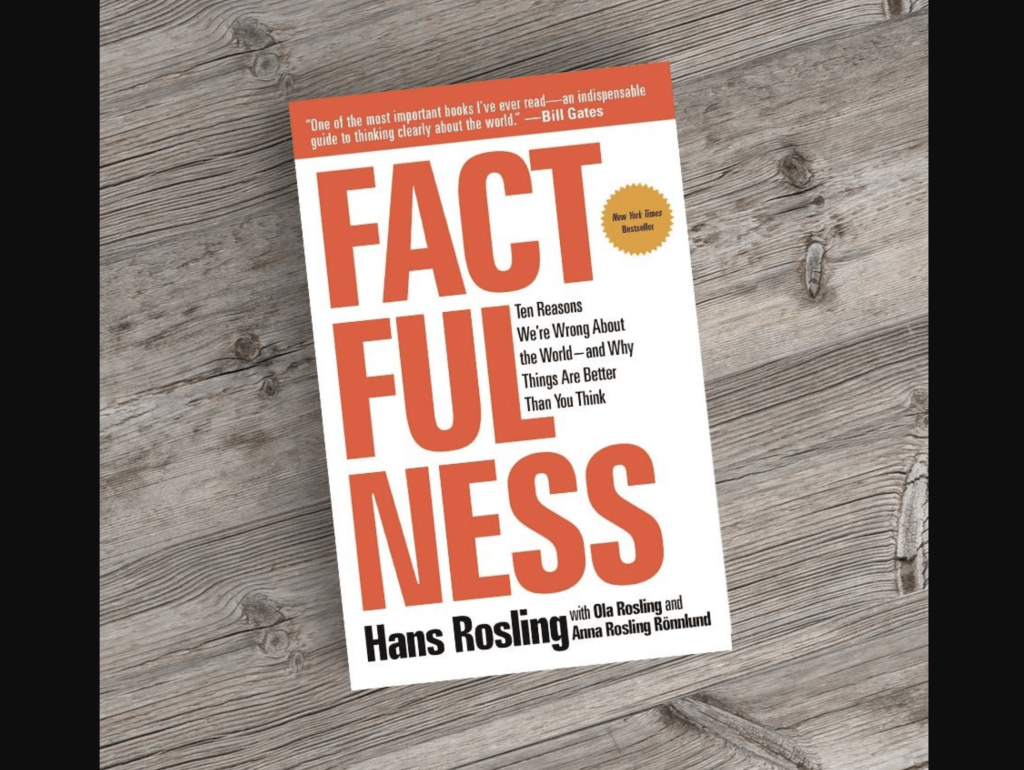
Okay, so factfulness is an invented word, and I’m usually not a fan of invented words. But this one was created for the title of a book–Factfulness: 10 Reasons Why We’re Wrong About the World–and Why Things are Better Than You Think, to make it stand out. It’s not really meant to be used in everyday conversation where fact and factual continue to work fine on their own, so I’ll give factfulness a one-time pass.
You may have heard of the principal author, Hans Rosling, a Swedish medical doctor and global health expert, through his TED talks. He passed away in 2017, shortly after finishing this book, which was published the following year. All that aside, before you read on in this post…
STOP NOW & take his quick & easy quiz!!
Everybody loves quizzes, right? This one is the same one that begins the book. Taking it online, though, allows you to see how you score on each question as you go along, learn how your answers compare with others, and access supporting details.
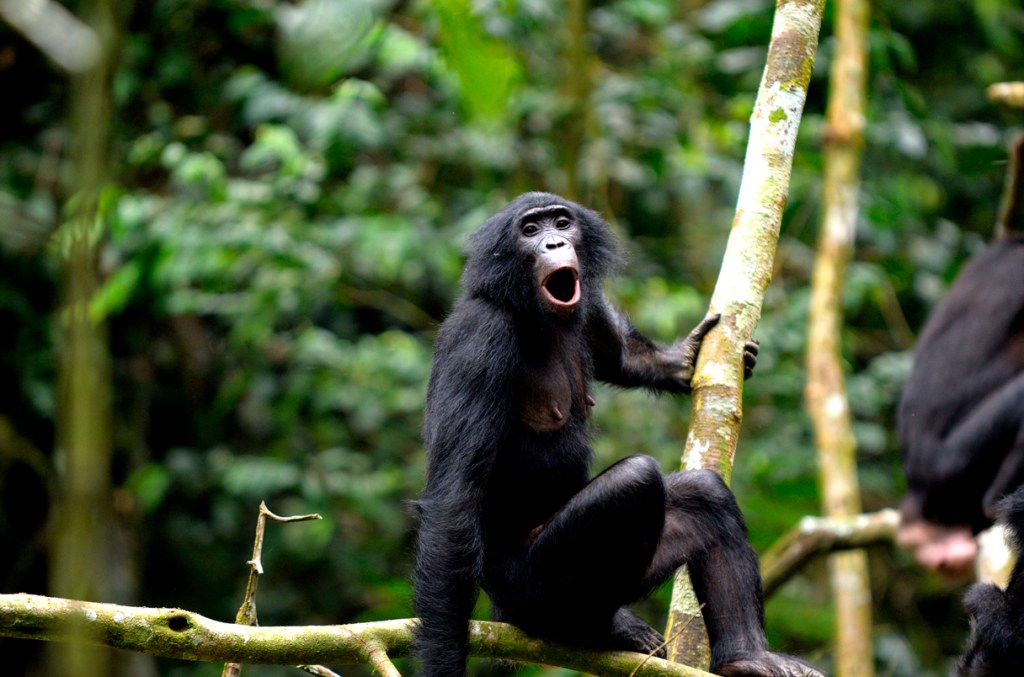
And don’t feel bad if you don’t do well. Only 7 percent get it all right. In fact, the author contends that chimpanzees, picking randomly, would score 33 percent. My first time out, before reading the book, I got just one right! In a retake a few months after finishing the book, I still missed two. It took me three tries to score 100 percent.
My lackluster results were a great attention-getter because I HATE getting a bad score on anything. In fourth grade our teacher hung a big poster on the wall with all of our names on it and pasted a gold star beside a name every time that person achieved 100 percent on an assignment. I was DETERMINED to beat out my classmates, and I did! I got to keep the chart and some stupid keychain. A silly prize, I know, but hey, I was 9.
I hope you do better than I did on this quiz, but the point is to be persistent. The pursuit of knowledge is its own reward–decidedly better than any keychain.
Just don’t stop with the quiz!
Read the book (it’s FREE with a Kindle Unlimited subscription). More than 50 years later, less-than-perfect still gets to me, so I read the book AND took it to heart AND wrote this review because starting with the correct data makes a difference. Those common misperceptions of ours lead to opinions built on incorrect information, thus bad decisions, and eventually, conflict.
Why are our perceptions about the world so out of whack? It’s our own dramatic instincts coupled with an overdramatic worldview, fed to us through television, printed digests, movies, advertising, books, and the Internet and social media, to name a few. That’s not the same as “fake news.” Rosling writes…
The human brain is a product of millions of years of evolution, and we are hard-wired with instincts that helped our ancestors to survive in small groups of hunters and gatherers. Our brains often jump to swift conclusions without much thinking, which used to help us to avoid immediate dangers…but we live in a very different world now…Uncontrolled, our appetite for the dramatic goes too far, prevents us from seeing the world as it is, and leads us terribly astray.
The book has been criticized for having an overly simplistic approach designed to lull us into feeling better about the world and ourselves as we dismiss the needs of others less privileged. But I think reviewers who come to that conclusion miss the point. It’s about helping people see the bigger picture and putting information into the accurate context through research and awareness. Don’t go with the drama. Look beneath it.
“Illusions don’t happen in our eyes,” Rosling writes. “They are not a sight problem. They are systematic misinterpretations,” which should make us curious to find out how the illusions work. Data can actually be the therapy that reveals the world is not as dramatic as we believe. We CAN make sense of it.
Analysis of a seeming illusion
Rosling held a childhood fascination with the circus that followed him into adulthood. While at med school, he heard a professor explain how the throat worked using an X-ray of a sword swallower to illustrate. “If something is stuck, the passage can be straightened by pushing the chin bone forward,” the professor said.
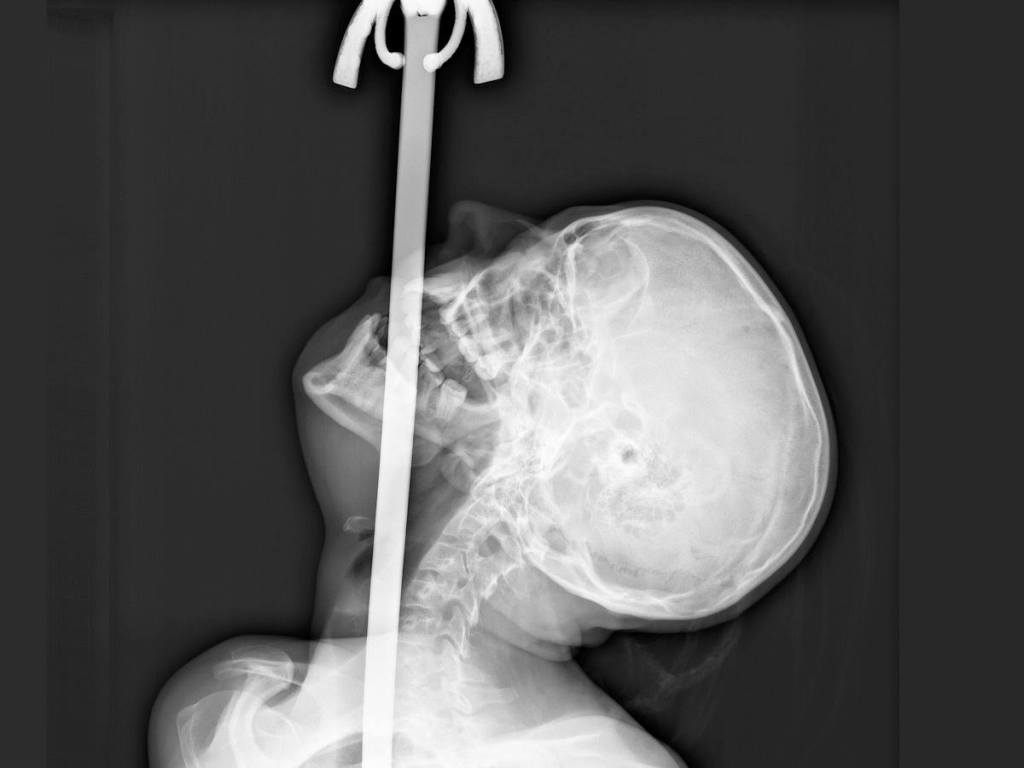
Rosling then began experimenting by trying to swallow a fishing rod with little luck. That is, until, as an intern, he treated an actual sword swallower–the one from the x-ray in fact! When Rosling shared his own attempts to learn the trade, the man said, “Young doctor, don’t you know the throat is flat? You can only slide flat things down there. That is why we use a sword.”
That’s how Rosling finally realized his childhood dream and went on to swallow a sword for real at the end of some of his presentations. Why would he do this?
I swallow the sword because I want the audience to realize how wrong their intuitions can be. I want them to realize that what I have shown them–both the sword swallowing and the material about the world that came before it–however much it conflicts with their preconceived ideas, however impossible it seems, is true. I want people, when they realize they have been wrong about the world, to feel not embarrassment, but that childlike sense of wonder, inspiration, and curiosity that I remember from the circus, and that I still get every time I discover I have been wrong: “Wow, how is that even possible?”
And then to find out how it IS possible: To look beyond what’s thrown at us in a daily barrage of frightening images and fear-mongering opinions.
Turns out the world is more than ‘the west’ & ‘the rest’
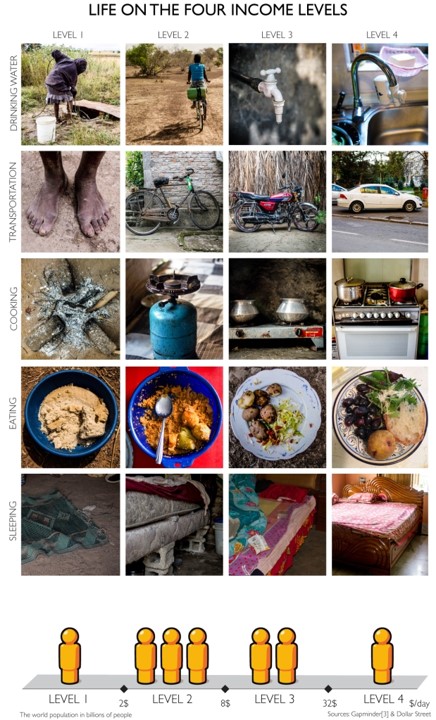
We are more than “us” and “them,” “developed” and “undeveloped.” More accurately, Rosling says, the world divides into four income levels, and the majority of its population exists in the middle two levels, while the highest and lowest levels include about the same number of people.
By far my favorite part of the book involves showing what life looks like for people in each of those four income levels through photographs the authors commissioned. You see specifically what access to water, transport, cooking and a plate of food looks like, and learn what healthcare is available, along with an average income per day and what has to happen for a person in one category to move up to the next.
Follow the book to the website
GapMinder was developed in conjunction with the book and is maintained by the two coauthors remaining since Hans Rosling’s death. It reproduces much of what’s in the book but in compelling visuals. It not only incorporates updates to United Nations statistics as they become available, but also makes use of full-color, animated charts, videos and other illustrations that make gap spreads in the data jump off the page. While the world is slowly improving in key categories, these spreads show what still needs work and where.

You can also launch an animated chart that shows how the world has changed over time and zoom in to look more closely at detail. Check out what life looks like around the world on the Dollar Street section, which is done with video and sound.
In addition to the Gapminder 2017 quiz I asked you to take at the beginning of this post, there are additional misconception quizzes about sustainable development, climate, UN goals, and specific parts of the world.
It all will open your eyes, but only if you’re willing to look beneath the illusion to the facts as they exist in context. As Rosling says…
Keep in mind that positive changes may be more common, but they don’t find you. You need to find them. (And if you look in the statistics, they are everywhere.)
You might also enjoy…
- Exploring David Brooks’ ‘How to Know a Person’
- A Meaningful Encounter: Connecting Over Culture & History at Clinic Check-in





 & {sometimes} WHY
Leave a comment