
While I’m on the subject, here’s another story about my former boss, Pam. In case you didn’t already read BN@TB#3, The Pitfalls of Petty Bosses, Pam was my on-and-off again boss during the 11 years I worked in the corporate communications department of a Fortune 500 electric utility.

Pam was honestly the hardest-working boss I ever had. But sometimes she could be petty (read BN@TB#3), and sometimes she talked out of both sides of her mouth.
The time burned into my memory was after a reorganization and appointment of a new director but before a merger. I had worked for her, then she moved from internal to external communications and I was promoted into her job, then my manager got moved to video communications, and Pam moved BACK to internal communications, and I worked for her again, alongside two other people who had been reporting to me.
Sounds like who’s on first or–if you’re old enough to remember–those TV chewing gum commercials for the Teaberry “shuffle”…
There be shenanigans afoot
Our new five-person team met weekly to talk about what needed done and divvy up the work. Next to Pam, I was senior person. Two of the other team members had previously reported to me. I had also lost out in the recent reorganization, so I was anxious to please and volunteered readily.
All went smoothly, or so I thought until my next review rolled around.
Everything typed in on my human resources review form was positive and I “exceeded expectations” all the way down the line. But then came the unrecorded comments.
“One of the team members feels you volunteer too quickly and they don’t get a chance at assignments they would like,” Pam says. I asked Pam who it was, and she wouldn’t say. “That’s not a criticism of you, in my mind,” she added. “But for this person’s development, I would appreciate it if you would hold back a bit in the future.”
I agreed. No problem. I made a point to let my coworkers express their preferences first. All was well, I thought.
Then the next review rolled around. “The same team member who felt you volunteered too quickly now feels like you’re shirking work,” Pam said.
I still don’t know why she even bothered to repeat this one to me, and I certainly can’t understand how she did so with a straight face. “I don’t think that,” she quickly added. “I know you’ve held back because I asked you to, and I told her that, and you’ve done what I asked. But I’d like you not to hold back so much now.”

Really?
“You’re still not going to say who this is, are you?” She shook her head. “Because that would explain a lot,” I said, “like maybe I could find the acceptable middle ground if this person and I talked about it directly.
“Actually, I can’t believe you even brought this up with me AGAIN,” I continued. “This other person needs to get over it and stop griping or talk to me directly. And that’s what you should relay to them. Are we supposed to be sitting in our review meeting grousing about the other team members? Is that helpful?”
To her credit, she dropped it.
The hidden subtext
Talking out of both sides of your mouth is an old expression, synonymous with lying.
To talk out of both sides of one’s mouth means to change one’s advice or opinion depending on who one is talking to or what situation one finds herself in. Consequently, none of the opinions expressed are honest. The person is making statements merely to ingratiate herself with different individuals or groups. People who talk out of both sides of their mouths are typically viewed as hypocritical, undependable and insincere.
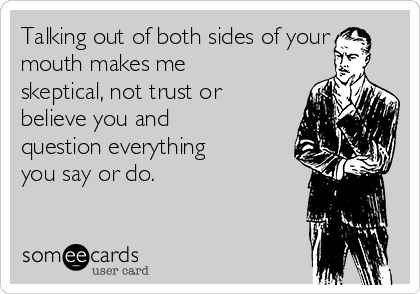
The origin of the idiom talk out of both sides of one’s mouth is unknown. Some trace it to a passage in the Bible, Proverbs 4:24:
Put away from you crooked speech, and put devious talk far from you.
A more likely inspiration for the idiom is the ancient idea that the right side of anything is positive, and the left side is sinister. Is it relevant that I was the only lefthander on the team? Probably not.
Of course, I wondered if Pam made the whole thing up just to drive a wedge between me and the employees who had before reported to me. She also could have been lying to them about me. After all, if she made me suspicious of either or both of them, perhaps she would then have something to note on my review the following year that didn’t meet expectations. Something on the record.
But I made sure she didn’t get that chance. I always worked hard. I always looked for new challenges because that’s what kept work interesting.
And I always watched out for whatever Pam might try next.
You might also enjoy…
- BN@TB#6, Navigating Toxic Leadership in Education: A Former Teacher’s Story
- BN@TB#5, The Carbon Copy Controversy: a Reporter’s Dilemma
- BN@TB#3, The Pitfalls of a Petty Boss
- BN@TB#2, Behind the Scenes of a First Job: A Reporter’s Tale
- BN@TB#1, Surviving a Screaming Boss: My Internship Story
Please use the comments to share
Has a boss ever pulled something like this on you? How did you handle it?









 & {sometimes} WHY
Leave a reply to rebecca Cancel reply