Child stars generally don’t receive top billing, but they always steal the show IMHO. These classic films from the 1950s are no exception, even though a search for their names leads to the bottoms of promotional posters and calls for a magnifying glass to read.

Seems like from the 1970s onward, the only time we heard what happened to young performers was if they got in trouble with the law or substance abuse or both, so I thought it would be fun to include a little background–and going-forward-ground–on the three performers featured in this week’s classic picks. None of them, BTW, had drug problems, though two became disillusioned with showbiz and went back to school.
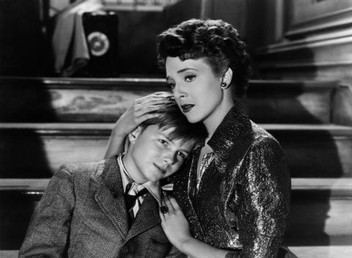
ORLEY LINDGREN: Lindgren was 11 when he played the son of a down-and-out jockey in “Under My Skin.” That same year he played Kirk Douglas’ childhood self in “Young Man with a Horn,” based loosely on the life of trumpeter Bix Beiderbecke. He loved football and was good with horses, but by 1953 had become a leggy teenager and no longer fit the “boy-as-hero” plotline. His final performance was in a 1954 episode of the TV show “The Adventures of Ozzie and Harriet.” He’d picked up some technical skills, though, and worked behind-the-scenes, serving on the recording team in 1970’s “Gimme Shelter.” His parents encouraged him to go to college, and he eventually obtained a PhD from UC Berkely. He married in 1995 and retired from UC Davis as a business consultant. He’s 85.
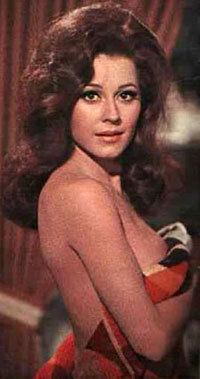
SHERRY JACKSON: Jackson was 11 when she played alongside John Wayne, who she credits with keeping producers from cutting her hair. A few years earlier, on the set of another movie, she became friends with actor Steve Cochran, who introduced a writer friend, Montgomery Pittman, to Jackson’s widowed mother. The two eventually married, with Cochran as best man and Sherry as flower girl. In 1955 Cochran hired Pittman to write “Come Next Spring,” and Pittman wrote the part of Cochran’s mute daughter Annie Ballot specifically for his stepdaughter. From 1953-58 Jackson played the older daughter, Terry Williams, on “The Danny Thomas Show,” known as “Make Room for Daddy” in its first three seasons. In 1967, in the international version of the movie “Gunn,” she appeared nude (see photo). Stills showed up in the August 1967 Playboy, under the heading “Make Room For Sherry.” Jackson had a continuous career in movies and television and was last seen onscreen in 1992 in the soap opera “Guiding Light.” She never married and is 83.
EDDIE HODGES: Hodges was 12 when he appeared alongside Frank Sinatra. He achieved fame on stage, screen and in music, being awarded a Grammy for his contribution to “Music Man” on Broadway. At age 14, he recorded the Isley Brothers’ single “I’m Gonna Knock on Your Door,” which rose to number 12 on the U.S. Billboard Hot 100 chart. The video here shows him reprising it on Swedish TV in the 1990s. Hodges became disillusioned with show business after a stint in the Army in late 1960s and returned to his native Mississippi to attend the University of Southern Mississippi, where he received a B.S. in psychology and an M.S. in counseling. He became a mental health counselor and retired after a long career. At age 78, he is divorced, the father of two children and the grandfather of six.
Now, on to the movies they starred in…
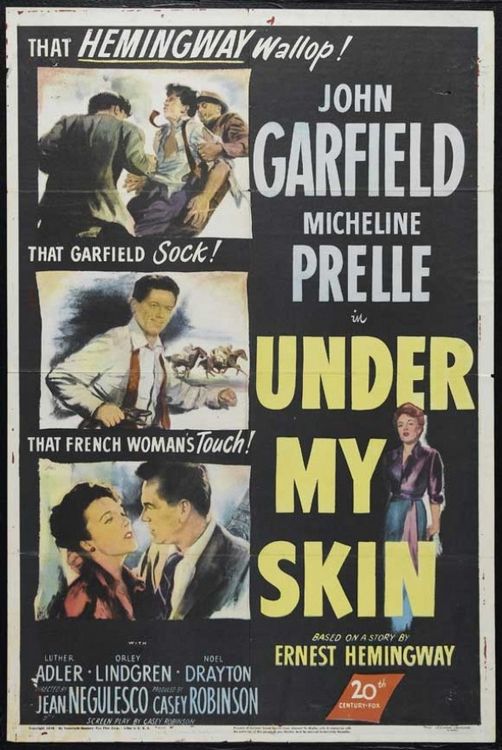
Under My Skin
RELEASE DATE: 1950 DIRECTOR: Jean Negulesco STUDIO: 20th Century Fox HEADLINERS: John Garfield, Micheline Prelle, Orley Lindgren, Luther Adler RUN TIME: 1 hour, 26 minutes FILMED IN: Black & White IMDb RANK: 6.5
SYNOPSIS: On the run from gamblers he double-crossed by winning a race he’d agreed to throw, expatriate jockey Danny Butler struggles to justify his son’s faith in him as a winner.
NOTES: Based on the 1923 short story “My Old Man” by Ernest Hemingway, who co-wrote the screenplay. Although much footage was shot in Europe, the principal stars remained in California. Production shut down for three weeks because Garfield had a heart attack. This was Prelle’s first Holly wood film, though she played in a number of French films prior, billed under her real name, Micheline Presle. She portrays a cabaret owner and singer and that’s her own sultry voice performing three different numbers.
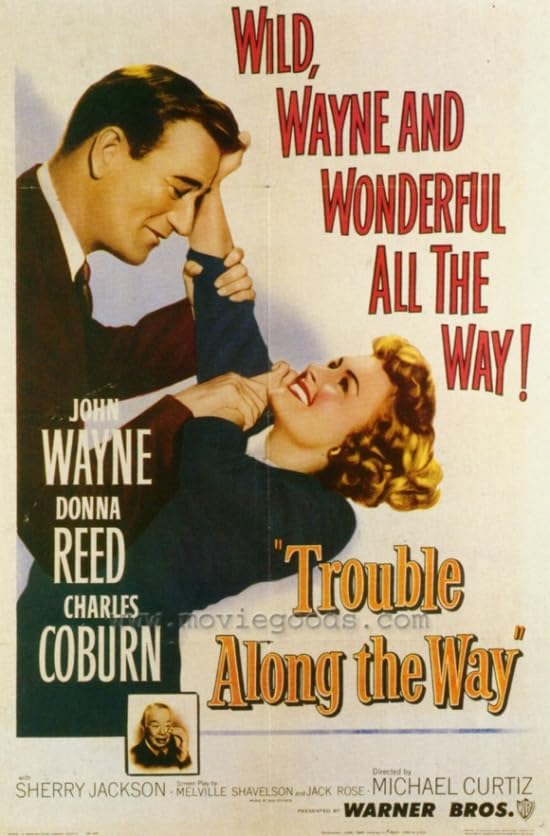
Trouble Along the Way
RELEASE DATE: 1953 DIRECTOR: Michael Curtiz STUDIO: Warner Brothers HEADLINERS: John Wayne, Donna Reed, Charles Coburn, Sherry Jackson RUN TIME: 1 hour, 51 minutes FILMED IN: Black & White IMDb RANK: 6.8
SYNOPSIS: Struggling with a social worker to retain custody of his daughter following his divorce, football coach Steve Williams finds himself embroiled in a recruiting scandal at the tiny Catholic college he’s trying to bring back to football respectability.
NOTES: The college Wayne’s character goes to work for is named for St. Anthony, the patron saint of lost causes. The $170,000 debt it’s trying to address equates to about $2 million today. External college scenes were shot at Pomona College, Marymount University, Loyola High and various other Los Angeles high schools. Football game scenes were filmed at the Polo Grounds in New York, which at the time was home field to the NFL’s New York Giants. Wayne played football for University of California in 1925-26 and did many of his own stunts for this movie. During a tackle, he injured his right arm and wore it in a sling off-set. He was right-handed, but learned to throw and write left-handed for filming. Wayne and Reed reportedly did not get along. Jackson’s character credits Wayne’s character with telling her, “Winning isn’t everything, it’s the only thing,” but the real source of that saying is UCLA Bruins coach Red Sanders (not Vince Lombardi, as many believe). Three cast members would soon star in three of the most popular series of the 1950s-60s: Sherry Jackson in “The Danny Thomas Show,” Donna Reed in “The Donna Reed Show,” and Chuck Connors in “The Rifleman. Watch for James Dean’s uncredited appearance as a game spectator.
LINKS: Trailer | Full film | Rent/buy
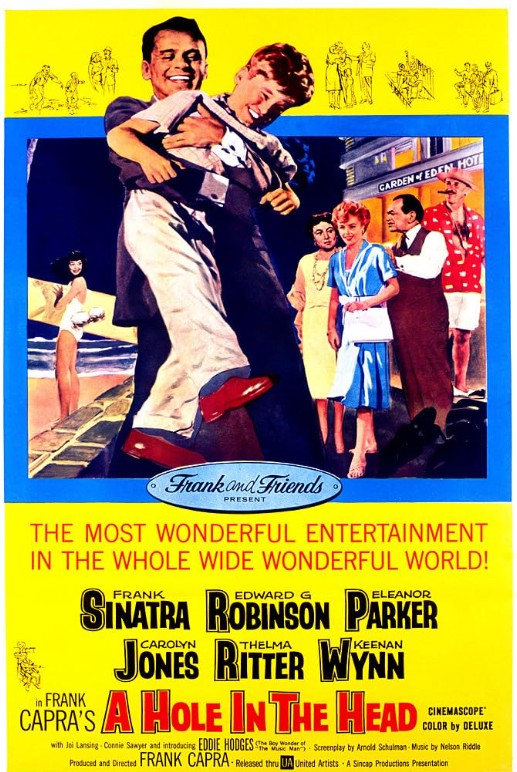
A Hole in the Head
RELEASE DATE: 1959 DIRECTOR: Frank Capra STUDIO: United Artists HEADLINERS: Frank Sinatra, Edward G. Robinson, Eleanor Parker, Eddie Hodges Carolyn Jones, Thelma Ritter, Keenan Wynn RUN TIME: 2 hours FILMED IN: Color IMDb RANK: 6.2
SYNOPSIS: Widower Tony is trying to keep a small Miami hotel afloat while raising a 12-year-old son. He’s forced to ask his harried brother Mario for help, but he’ll only bail Tony out if he quits his bohemian lifestyle and marries a sensible woman.
NOTES: Adapted from a 1957 Broadway play by Arnold Schulman, who wrote the original version in a playwriting course in the 1940s as a one-act piece. When Garson Kanin expressed interest in producing it, Schulman revised it, and it opened on Broadway as “A Hole in the Head,” starring Paul Douglas. Sinatra saw the play, paid $200,000 for screen rights, hired Schulman to write the screenplay, and arranged a production partnership with Frank Capra to direct. After seeing Hodges on the TV quiz show “Name That Tune,” Capra introduced Sinatra to Hodges, then appearing in “The Music Man” on Broadway, and they hired him for what would be the young actor’s feature-film debut. Filming was at Miami Beach locations, including the Fontainebleau Hotel, West Flagler Dog Track, the Cardozo Hotel (which doubled for the fictional “Garden of Eden”) and the South Beach oceanfront area. After most of the cast and crew returned to California to shoot interiors, a second unit remained in Miami Beach to shoot the opening credit sequence, featuring cast names and the title connected to 300 feet of netting pulled by the Goodyear blimp to the sound of Sinatra singing “All My Tomorrows.” The new high-speed Panatar lens developed by Panavision for color photography allowed outdoor night scenes to be shot with one-tenth the lighting normally required. The party scene at the Fontainebleau Hotel included water skiers from Cypress Gardens, two orchestras, wild birds and 85 mostly local beauties. Capra also reused a gag from a previous movie in which the protagonist carries a woman up a flight of stairs while walking backward and without realizing it continues climbing up the steps of a ladder before falling. The song “High Hopes” won an Oscar for best song. In the movie, Sinatra and Hodges performed it together, but when Sinatra later recorded it for Capitol Records, Decca refused to let Hodges participate. Capra wrote in his autobiography that Sinatra’s acting suffered from repeated rehearsals, so he had the other actors rehearse without Sinatra and only brought him in when ready for filming. When the film was shot, South Beach was overshadowed by surrounding large hotels, but beginning in the mid-1980s ir was revitalized. The 1939 art deco Cardozo was completely renovated and subsequently reopened as a small luxury hotel, in keeping with the now trendy South Beach neighborhood. The “Florida Disneyland” Sinatra’s character dreams of became a reality in 1971 when Disney World opened in Orlando. Maybe this film gave Walt the idea?
LINKS: Trailer | Full film | Rent/buy
Use the comments to share…
- If you have seen one of these movies and what you thought of it
- If you have a favorite movie about single-parenting
You might also enjoy other Classic Movie Buzz posts.







 & {sometimes} WHY
Leave a comment