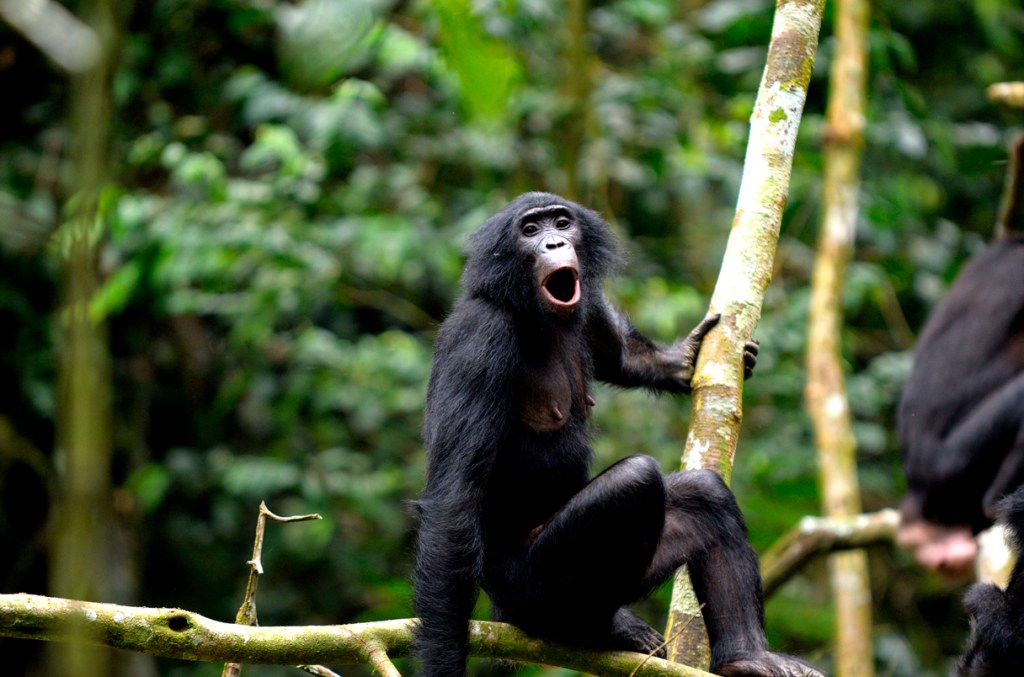
The April 2025 issue of Science magazine reports that a study of bonobos–thought to be the human’s closest evolutionary relative–shows the primate species can do what humans do: combine expressions into “nontrivial” combinations. But I’ve got news for scientists, my two cats can do that and more. And friends have told me similar stories about their pets.
First, some background…
BONOBOS VS. CHIMPS
Also called a dwarf chimpanzee, the bonobo is thought to be a species in its own right. They have longer limbs than chimps and pinker lips but darker faces and tail-tufts through adulthood.
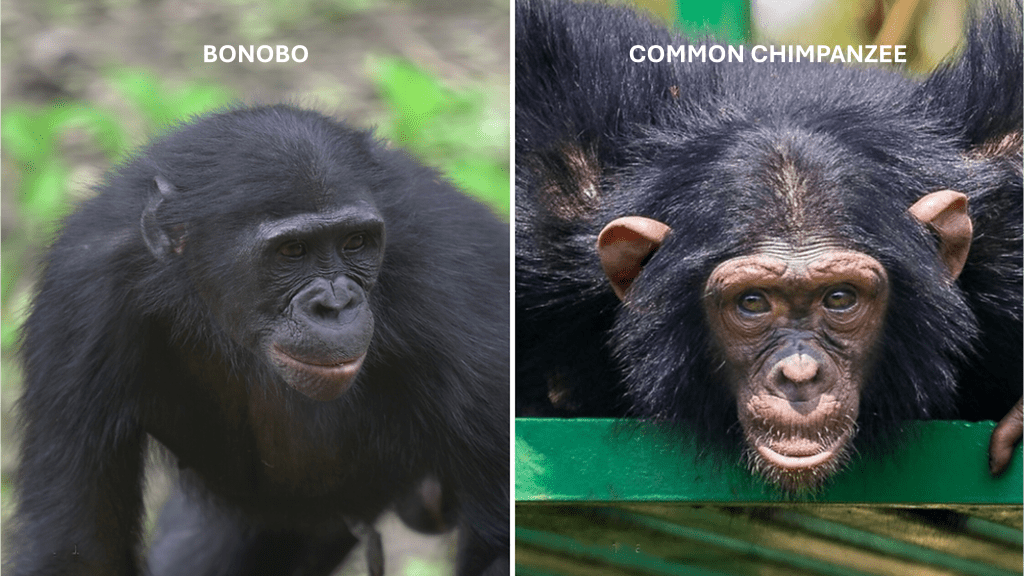
The big difference, though, is habitat. Chimpanzees are widely distributed across equitorial Africa north of the Congo River, while bonobos live only in the lowland rainforests south of the river in the Kokolopori Bonobo Reserve. The river acts as a natural barrier separating the two species and inhibiting interbreeding.
Political unrest in the Democratic Republic of Congo has prevented much study of the protected species until recently, but now a study is out that scientists say is “pivotal” and “will change the face of the field.”
TRIVIAL VS. NONTRIVIAL COMMUNICATION
Scientists already know many species combine their calls, but only in “trivial” combinations that simply add the meanings together. Human speakers, though, combine words into “nontrivial” combinations where the meaning is more than the sum of the parts. For instance…
“Tall cook” is a trivial combination—it means someone who is tall and a cook. But “good cook” is not someone who is good and a cook: They might be good at cooking, but terrible in other areas—perhaps a dangerous driver. This combination of words generates a new meaning.
And this more nuanced combining of vocalization, found previously only in humans, is what University of Zurich researchers say happens among bonobos. Researchers recorded more than 700 different vocalizations, many of which were combinations of two calls. Here’s how trivial vocalizations called “low hoot” and “high hoot” communicated messages more than the sum of low and high meanings when combined:
“Low hoot,” the team found, is often used in situations of high excitement, and appears to mean something like “I am excited.” “High hoot” is used when bonobos want to alert others to their presence and may mean “Pay attention to me.” But the combination of the two calls doesn’t simply mean “I am excited, pay attention to me”; instead, it conveys a more nuanced message. It is used specifically when another individual is putting on an aggressive display. The bonobo using this call combination might be trying to stop the other individual from displaying or get others in the group to pay attention to the caller, the authors suggest.
?????
Okay, I get the human example, but I’m not so sure I’m hearing what the researchers think they’re hearing from the bonobos. It needs more study is all I’m saying. I’m all for science–the more we learn about ANYTHING, the better–but…
Sometimes science misses the obvious
Take our two cats, for instance.
Yes, they talk to each other, and different vocalizations between them mean different things, though I’ve never tried to catalog their “speech” or determine whether what they’re saying to each other is trivial or nontrivial. It’s important to them and they seem to understand each other, but I can’t pretend to know for sure.
And even though I haven’t mounted a scientific study, I’d never insult them by suggesting ANYTHING they do or say is trivial. But I do believe that our cats–and many household pets–do the bonobos one better! THEY communicate with US, their human caregivers.
Yes, our cats communicate to my husband and I. You don’t believe me? Hah to you! Here are some examples…
THE MAISIE NOD
If Maisie wants food, rather than running around the house crying like her brother Scout does, she gets our attention, sits by the timed feeder and nods. First toward the feeder then back to us, like she’s saying, “Hey stupid, the bowls are empty.”
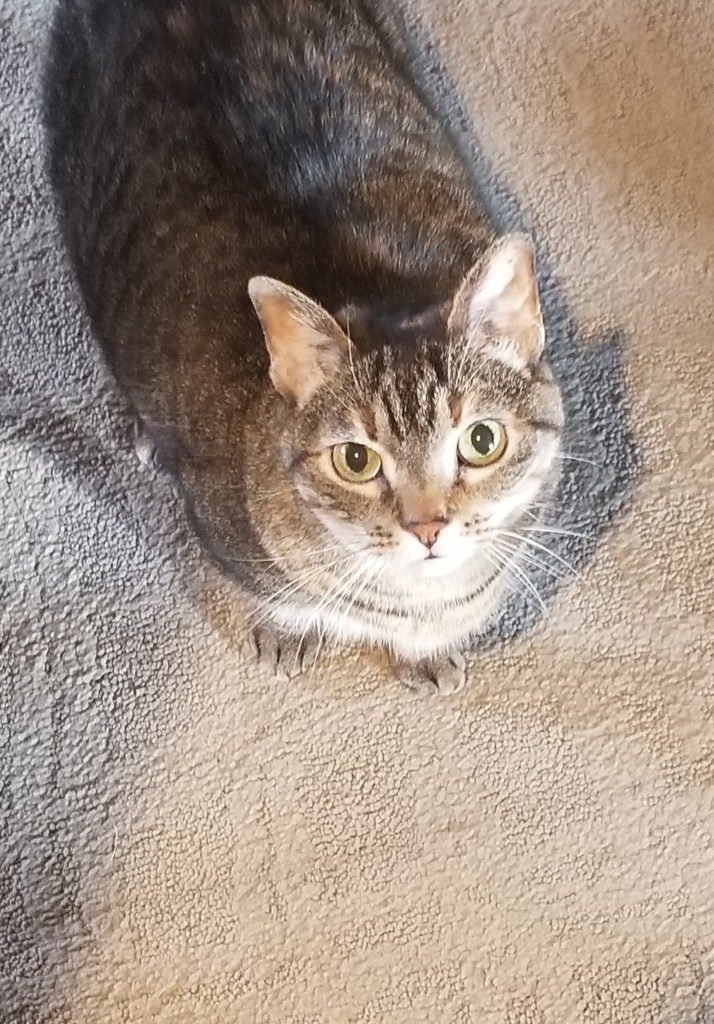
She does the same when she wants brushed, nodding at the brush or jumping onto the ottoman where hubs always sits to brush her.
She has impeccable manners, usually, and seldom makes a spectacle of herself like her brother Scout (keep reading). Though she did tattle on me to hubs about closing the craft room door (she prefers ALL doors open, all the time).
SHARE & SHARE ALIKE
The other day I finished a jigsaw puzzle, except for two missing pieces. Sometimes I drop them or they get caught on my sleeve and fall to the floor. I’ve even found them in the pocket of my robe. Other times, Maisie steals them, chews on them, then discards them. I’ve seen her, and I’ve retrieved the saliva-soaked-and-swollen pieces with fresh teeth marks.
Hubs and I searched for these two missing pieces to no avail. I left the puzzle out, hoping to find them before I traded it in at the library. A day later, one of the pieces magically reappeared. Not on the floor or in a corner but on top of my work table. As if to say, “Here mom. I had this and I heard you needed it back and so I brought it where you’d know it was me who did this.”
Unfortunately, she didn’t bring back the second one. But that’s her cat nature and more evidence of her superiority. She thought we should split the find 50-50.
SOOOME CAT!
Both Maisie and Scout know the meaning of some words, most of which are related to food, medicine, grooming, and going in or out in the summer. I’m sure many pet owners could claim as much.
But we use “lagniappe” to refer to an extra, small taste of wet food we give them after we put on our jams. And every time we head toward the bedroom and bathroom after dinner, Scout accompanies us, twining in and out between our legs and purring, stretching out and making us walk around him.
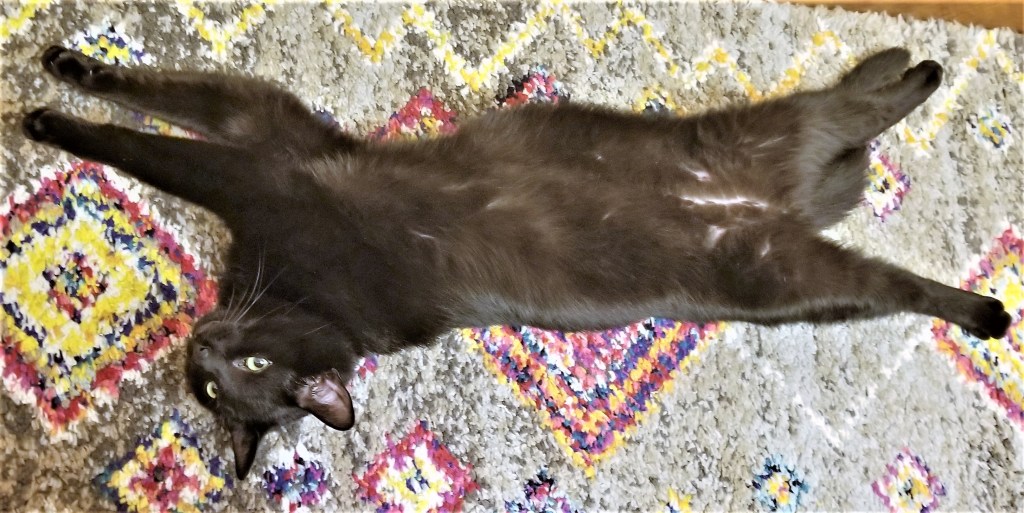
If we spend too long at the dinner table, he whines and “accidentally” sinks his front claws into our thighs.
Ouch!
Naysayers may contend he just has the timing and sequence of events down, and that’s probably so. But doesn’t that count as nontrivial since he combined time, sequence and word recognition with vocalization and actions of his own? Sounds pretty complex to me!
RAIDER OF THE LOST TOYS ARK
I keep spare cat toys–refills actually–in a wooden box, carved and painted with a cat decoration, that my husband bought me long ago.
At our previous home, I stored it on top of a tall cabinet. Here I slide it under a chair in my craft room. The cats know what’s in there and always gather round if I open the box because they know something fun’s coming out. It has a heavy hinged lid, and the chair over it prevents it from being opened.
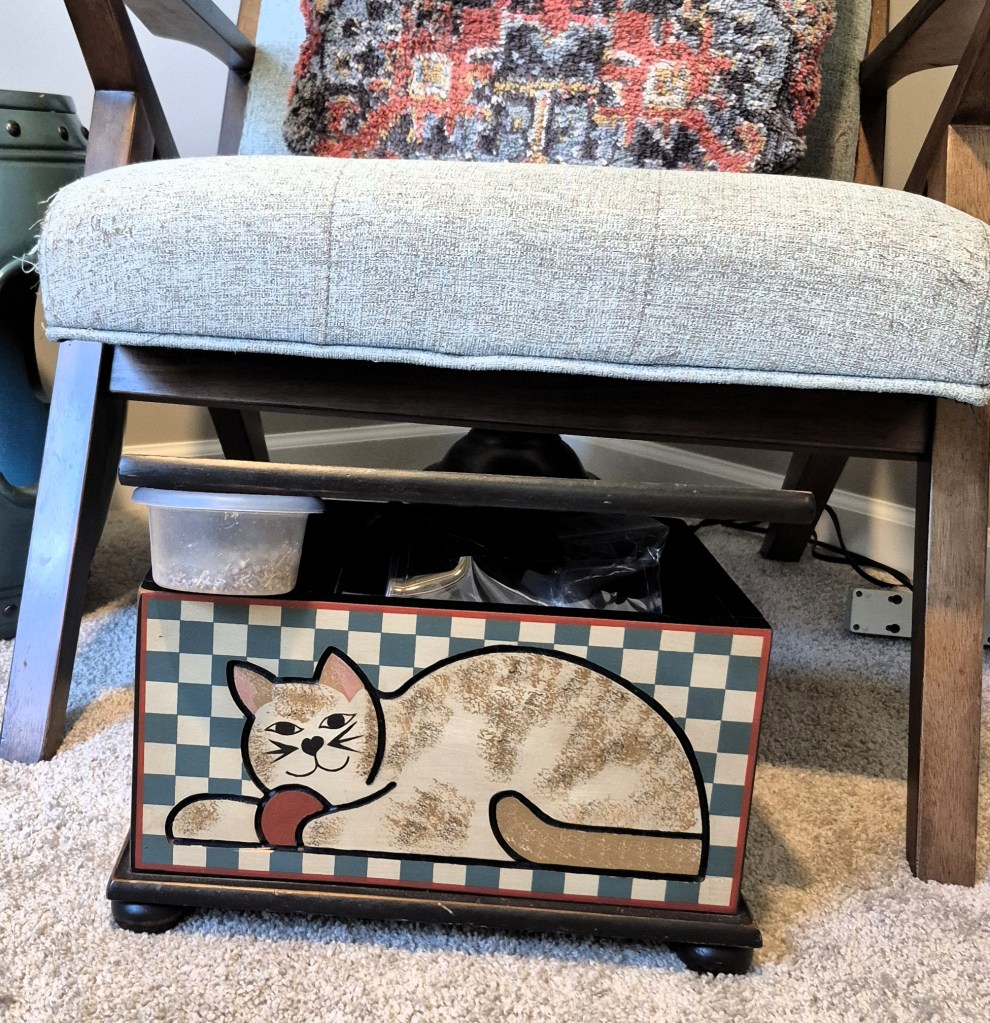
That is, until a few weeks ago. We started seeing all these “refill” toys everywhere–fringy worms and feathers for the fishing pole, sparkleballs, soccer balls, puff balls, plastic springs, etc. When we looked in my craft room, the box had been pushed forward from behind, out from under the chair, and the lid wedged open with a container of catnip.
My guess is Scout is the culprit since he’s always the one to scatter toys from the official toy basket in my study after we’ve collected them and put them away so we can vacuum.
I bet you’re saying, That doesn’t involve any vocalization at all, and you’d be right. But it was pretty slick, don’t you think? It was most certainly communication from Scout to me: “Mom, I’m bored. I need access to these other toys going to waste in that box. If you won’t get them for me, I’ll get them myself.”
Necessity IS the mother of invention.
In Scout’s mind it was anything but trivial, and it involved the use of ingenuity to figure out how to do it, as well as the use of fine motor skills to put the plan into action.
GLAD-WRAPPED
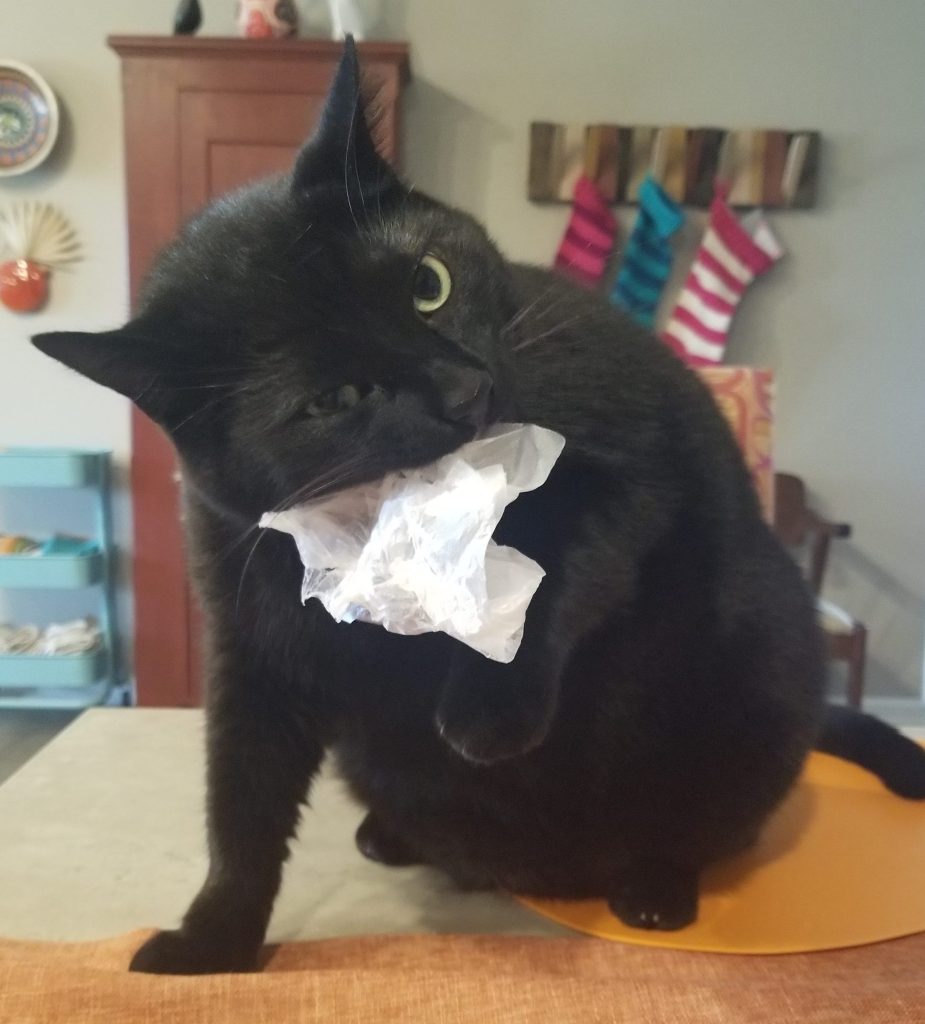
One last Scout story: He recognizes the sound of Glad Press and Seal being unrolled from the box or removed from a container.
It calls him to the kitchen from all points in the house because he loves to chew it.
Sometimes he even steals it from the container it’s covering and runs off with it.
Okay, that’s probably “trivial.” But it’s danged cute, right?
Ask any pet-owner…
Their pets are wizards. I know mine are MOST exceptional.
My massage therapist told me of another client whose dogs know how to spell. So they not only go crazy when their owners say “Treat?” or “Walk?” they bark and hop around when the owners spell t-r-e-a-t and w-a-l-k.
No outsmarting THOSE canines!
An evolutionary linguist (???!!) commenting on the bonobos study pointed out that communication research in great apes has often focused on gestures rather than vocalization and suggests similar studies on other primates, including chimpanzees, gibbons and marmosets.
Me? I think they need to start with my cats, especially with all the defunding of scientific research going on right now. Payment in tuna and sparkleballs accepted.






 & {sometimes} WHY
Leave a comment