Everybody loves a courtroom drama, including me. The actual courtroom? Not so much. I’ve served as an alternate juror twice–once in a murder trial. The pace is slow, the presentation of evidence is complex and tedious, and the lawyers largely lack charisma.
But the worst part is being stuck with the other jurors. Deliberation takes place in a purposely small jury room, but most of the time spent in that room isn’t spent deciding guilt or innocence. It’s when the attorneys and judge need to discuss something without the jury present. And believe me, THAT’S when you get sick of the other dutiful citizens.

One time, two fellow jurors, who happened to be Black, were discussing silicone lip injections. I simply commented that the idea of such injections made me squeamish (I meant, because any kind of plastic surgery makes me squeamish), but these women thought I was making fun of full lips. The one replied to me something about white women having puny lips and thinking they looked great. Then she wouldn’t talk to me the rest of the trial. I was confused.
Another time there was this creepy male juror, who, when I was putting lotion on my hands (it was the dead of winter; they were chapped), asked for a rubdown. The same guy tried to coax me through a too-narrow space between him and another juror, but I refused and waited for him to move, which he took his time about.
I should have reported that guy. Next time, maybe, which will likely never happen. There’s something to be said for being over 65 and being excused from that duty.
Anyway, these three classic courtroom dramas will keep you guessing about who’s guilty and who’s not, as well as who will beat the wrap and why. And you won’t have to get up-close-and-personal with defendants, witnesses, lawyers or fellow jurors. So jump into your jammies and slipper socks, curl up on your living room sofa under a heated throw, and press PLAY.
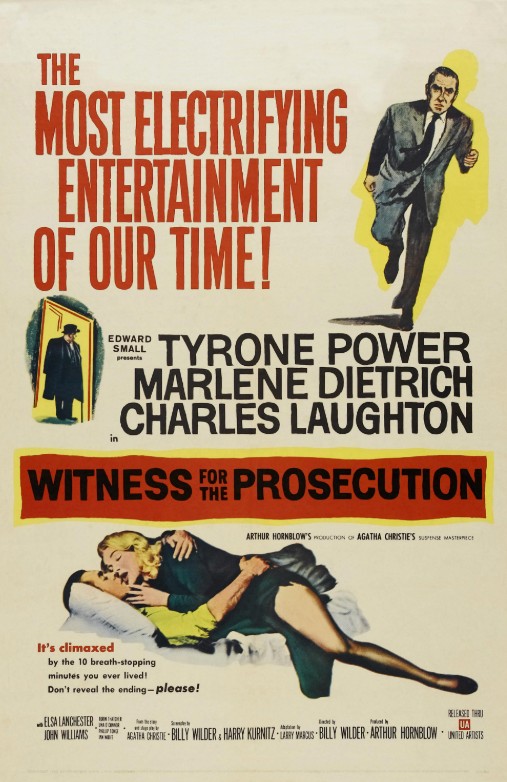
Witness for the Prosecution
RELEASE DATE: 1957 DIRECTOR: Billy Wilder STUDIO: United Artists HEADLINERS: Tyrone Power, Charles Laughton, Marlene Dietrich, Elsa Lanchester RUN TIME: 1 hour, 56 minutes FILMED IN: Black & White IMDb RANK: 8.4
SYNOPSIS: A famous but ailing barrister agrees to defend a man in a sensational murder trial in which the man’s self-possessed wife offers confusing testimony.
NOTES: Based on a 1925 Agatha Christie short story that she then made into a play. Both the story and play have different endings, and principal cast members in the movie did not how it would end until the last day of shooting, when the final 10 pages of the script were passed out. All comic scenes between the barrister played by Laughton and his private nurse played by Elsa Lanchester (who were married in real life) were added by the screenwriters and are not in the original play. The courtroom setting, cost $75,000 to build and was a recreation of a real courtroom in London’s Central Criminal Courts, The Old Bailey. While it’s generally supposed that Dame Agatha Christie chose the name Vole for the defendant after the rat-like rodent of the same name, in fact, the word has several other meanings also relevant to this character. In cards, a “vole” is when one player wins all the tricks of a game. The expression “go the vole” can mean either to venture everything on the chance of great rewards or to try one thing after another, usually a variety of occupations. “Vole” is also a variant of the French verb “voler,”,which means both “to steal” or “to fly.” The 80,000 pounds willed to Leonard Vole in the movie would have been equal to $222,000 at 1952 exchange rates and is the equivalent of $2.7 million in 2025 dollars. This was the last film Tyrone Power finished. He died of a heart attack the following year.
LINKS: Trailer | Full film | Rent/buy
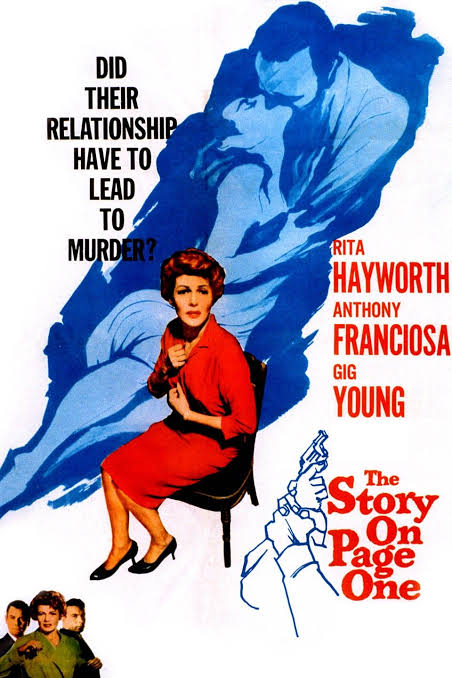
The Story on Page One
RELEASE DATE: 1959 DIRECTOR: Clifford Odets STUDIO: 20th Century Fox HEADLINERS: Rita Hayworth, Tony Franciosa, Gig Young RUN TIME: 2 hours, 3 minutes FILMED IN: Color IMDb RANK: 6.8
SYNOPSIS: An adulterous couple is accused of murder after the woman’s husband is shot and killed during a scuffle. A high-profile court case tells the story.
NOTES: Odets wrote the original screenplay as well as directing this film. It was his final film. Marilyn Monroe was the first actress considered for the part Hayworth eventually played. The $30,000 insurance money Jo stood to gain in her husband’s death equates to more than $305,000 in 2025.
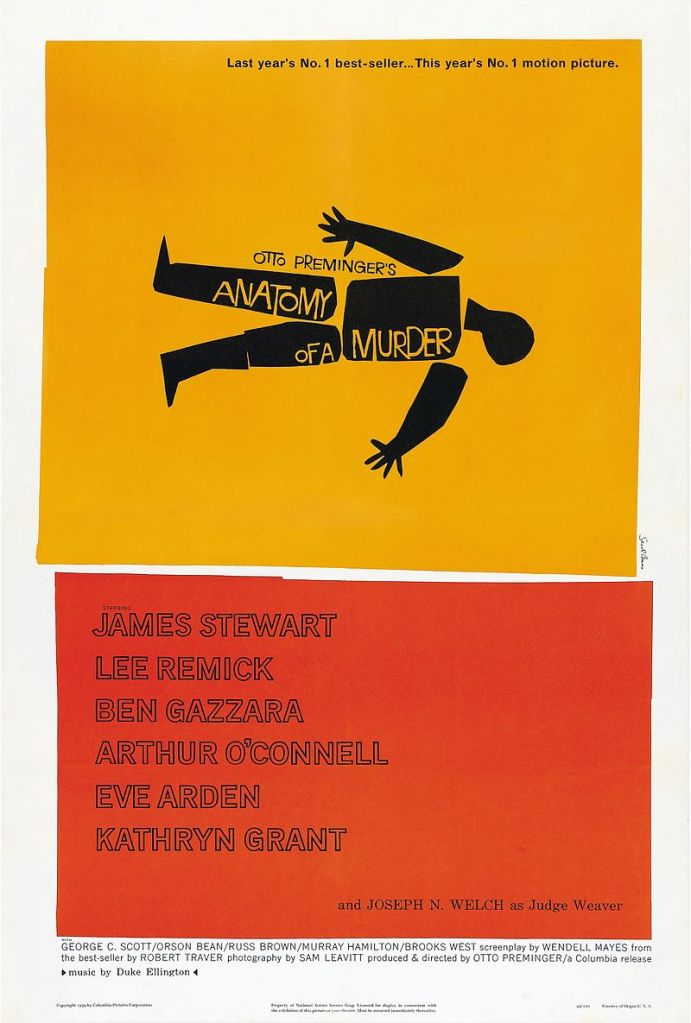
Anatomy of a Murder
RELEASE DATE: 1959 DIRECTOR: Otto Preminger STUDIO: Columbia HEADLINERS: James Stewart, Lee Remick, Ben Gazzara, Arthur O’Connell Eve Arden, George C. Scott RUN TIME: 2 hours, 41 minutes FILMED IN: Black & White IMDb RANK: 8.0
SYNOPSIS: Semi-retired Michigan lawyer Paul Biegler takes the case of Army Lt. Manion, who murdered a local innkeeper after his wife claimed he raped her. Over the course of an extensive trial, Biegler parries with District Attorney Lodwick and out-of-town prosecutor Claude Dancer to set his client free, but his case rests on the victim’s mysterious business partner, who’s hiding a dark secret.
NOTES: Based on the 1958 novel of the same name written by Michigan Supreme Court Justice John D. Voelker under the pen name of Robert Traver. Voelker based the novel on a 1952 murder case in Big Bay, MI, in which he was the defense attorney. Controversy surrounded this movie because it included use of the words “bitch,” “contraceptive,” “panties,” “penetration,” “rape,” “slut” and “sperm.” James Stewart’s father was so offended by the film, which he deemed “a dirty picture,” that he took out an ad in his local newspaper telling people not to see it. Scenes in Barney Quill’s bar were shot in the Thunder Bay Inn Tavern in Big Bay, MI, approximately 325 yards down the road from the Lumberjack Tavern, where the actual murder on which the novel and film are based, took place in 1952. Duke Ellington composed the music and has a cameo as “Pie-Eye. Otto Preminger was asked several times by authorities in South Africa to remove the brief scene of Stewart sitting next to Ellington, but he refused. This was James Stewart’s last Oscar-nominated performance and George C. Scott’s first. The performer playing Judge Weaver, Joseph N. Welch, was a lawyer in real-life who became a household name as counsel for the U.S. Army during the anti-Communist investigation commonly known as the Army-McCarthy hearings. Welch was widely thought to have helped release Sen. Joseph McCarthy’s stranglehold over the country when he stood up to McCarthy and his aide Roy Cohn in the hearings, saying, “Senator. You’ve done enough. Have you no sense of decency, sir? At long last, have you left no sense of decency?” This courageous stand has been seen as the turning point in finally defeating McCarthyism. Welch agreed to appear in this movie if his wife could have a role as a juror.
LINKS: Trailer | Full film | Rent/buy
Use the comments to share…
- If you have seen one of these movies and what you thought of it
- If you have a favorite courtroom drama movie
You might also enjoy other Classic Movie Buzz posts.





 & {sometimes} WHY
Leave a comment