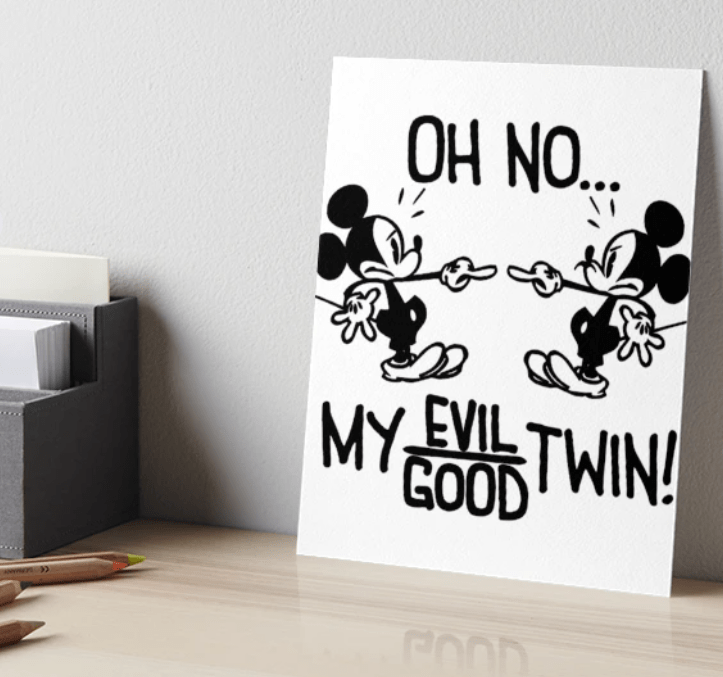
I’ve known a number of identical twins through the years, mostly during school. I could always tell which one was which from looks alone. And even though each was different in some behaviors and mannerisms, I never found any of the pairs to be one good and one evil.
Still, the idea of good-and-evil identical twins make for a compelling plotline in many a story, as these three movies attest. Twins are, in fact, the subject of many misconceptions, detailed in the book Twin Mythconceptions by a noted twin expert.
One popular notion, used in The Dark Mirror, is that an identical twin could commit a crime and frame the sibling. It might have worked in 1946, but experts say not anymore, that modern DNA testing can decisively distinguish the felon from the innocent twin.

“In general, the idea of good and evil identical twins, and the culture’s eagerness to deploy those labels to help tell siblings apart, is inaccurate and potentially damaging,” according to a Psychology Today review. “In fact, fraternal twins are more likely than identical pairs to diverge widely in personality because each inherited a different set of genes.”
That said, these three movies harbor a few coincidences that give us reason to pause:
- A Stolen Life and The Dark Mirror came out the same year, and the leading ladies in each–Bette Davis and Olivia DeHavilland, respectively–were best friends in real life. I wonder if they collaborated on method?
- Like the twin characters she played, DeHavilland also had a bitter rivalry with her real-life sister, Joan Fontaine, though they were not twins.
- Davis was the only actress ever to play twins twice. Many reviewers claim Dead Ringer is a remake of A Stolen Life, but not so. The stories are quite different, as are the twins themselves and Davis’ portrayals. Plus, the unproduced script for Dead Ringer had been sitting on a shelf at Warner’s for a couple years before A Stolen Life was even filmed.
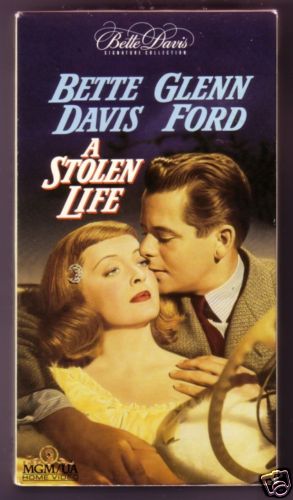
A Stolen Life
RELEASE DATE: 1946 DIRECTOR: Curtis Bernhardt STUDIO: Warner Brothers HEADLINERS: Bette Davis, Glenn Ford, Dane Clark, Charles Ruggles, Walter Brennan RUN TIME: 1 hour, 49 minutes FILMED IN: Black & White IMDb RANK: 7.2
SYNOPSIS: When a woman’s twin sister is drowned, she assumes her identity in order to be close to the man she feels her sister took from her years before.
NOTES: Based on the 1935 novel of the same name by Karel Josef Benes. The title could be considered a double entendre, as Pat first “steals” Kate’s man Bill, assuming the role in life Kate could have had with Bill, then after Pat’s drowning, Kate “steals” Pat’s identity in order to be near Bill, whom she never stopped loving. This was the only movie Bette Davis produced, and she insisted on Glenn Ford, who was under contract to Columbia, for the male lead. After seeing a secret screen test of Ford done by Davis, Warner gave in and paid Columbia to loan Ford. Davis, who was eight years older than Ford, tried to seduce him during shooting, but Ford declined. Davis and Ford later worked together in Frank Capra’s Pocketful of Miracles, but it was less than a pleasant experience for most involved. A 1996 biography of Davis singles out Ford with contempt because he told the press he used his influence with Capra to get Davis the part of Apple Annie. “I agreed to do a featured role for Mr. Capra,” Davis countered, “but Mr. Ford told the press he had gotten me the part–which he did NOT–because he thought I could use the break! The bastard. I didn’t expect him to continue being grateful for A Stolen Life, but neither did I expect an ego so inflated that he needed to make a false statement just to build himself up.” Capra said in his own autobiography that he didn’t like working with Ford either. The $69.50 negligee Bill buys for Pat in the movie, with Kate’s help, would sell for more than $1,100 today. If the main title theme sounds familiar, composer Max Steiner repurposed it in 1959 as a motif in A Summer Place. Many of the Oscar-nominated special effects pioneered by this film were employed later on in projects requiring actors to play their twin, including The Parent Trap in 1961, The Patty Duke Show in 1963, and Davis’ later twin film, Dead Ringer.
LINKS: Trailer | Full film | Rent/buy
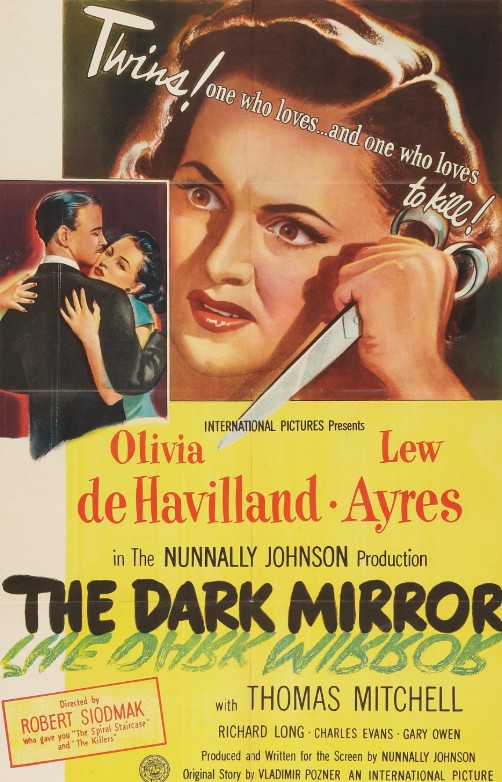
The Dark Mirror
RELEASE DATE: 1946 DIRECTOR: Robert Siodmak STUDIO: International Pictures HEADLINERS: Olivia DeHavilland, Lew Ayres, Thomas Mitchell, Richard Long RUN TIME: 1 hour, 25 minutes FILMED IN: Black & White IMDb RANK: 7.1
SYNOPSIS: A man is found murdered, and witnesses are sure about the woman they saw leaving his apartment. However, it becomes apparent the woman has a twin, and finding out which one is the killer seems impossible.
NOTES: Although the name pendants, monogrammed dressing gowns and brooches are swapped for plot purposes, Terry is consistently left-handed and the only smoker of the two. The suggestion of Terry being left-handed and Ruth being right-handed plays nicely to the plot of the twins being mirrored, but there is also a superstition context. As late as the 1970s in the US, parents were encouraged to force left-handed children to use their right hands. While this was often cloaked in nonsense about educational benefits, it was really a vestige of the ancient superstition that the right hand (and by extension, the right-handed) was good and the left hand (and left-handed) was evil. Even the Latin words meaning right and left, dexter and sinister, respectively, reflect this.
LINKS: Trailer | Full film | Buy

Dead Ringer
RELEASE DATE: 1963 DIRECTOR: Paul Henreid STUDIO: Warner Brothers HEADLINERS: Bette Davis, Karl Malden, Peter Lawford, Jean Hagen RUN TIME: 1 hour, 56 minutes FILMED IN: Black & White IMDb RANK: 7.3
SYNOPSIS: The working-class twin sister of a callous, wealthy woman impulsively murders her out of revenge and assumes her identity. But impersonating her dead twin is more complicated and risky than she anticipated.
NOTES: This was the third time Paul Henreid worked with Davis. He acted in two other films alongside her: 1942’s Now, Voyager and 1946’s Deception. Henreid called making this film “a wonderful experience.” Davis later said in a biography about her, “The original script of Dead Ringer was appallingly bad. Paul and I worked very hard to make it plausible at all. We did not completely succeed. We also were forced by Warner Bros. to change the ending we first filmed. The Warner ending was so ordinary. Paul Henreid did a beautiful job as director…plus Connie Cezon was such an unbelievable double for me–we could actually use her in some of the scenes.” Watch for Davis’ brief rendition of “Shuffle Off to Buffalo,” which TV stations were notorious for editing out so the film would play within a two-hour time slot with commercials. The uncredited jazz combo in Edie’s Bar included female electronic organist Perry Lee Blackwell and drummer Kenny Dennis, both noted musicians. Blackwell can also be seen as a lounge singer at the piano in the 1959 romantic comedy Pillow Talk, starring Doris Day and Rock Hudson. In that film, she, Day and Hudson do a comical, sing-along version of “Rolly Poly.” This was Jean Hagen’s last movie.
LINKS: Trailer | Full film | Rent/buy
Use the comments to share…
- If you have seen one of these movies and what you thought of it
- If you have a favorite movie about twins
You might also enjoy other Classic Movie Buzz posts.






 & {sometimes} WHY
Leave a comment