I admit I’m a sucker for that “word of the year” stuff publishers put out when transitioning from one year to the next. But the words they choose are getting less and less comprehensible to my 68-year-old processing center. And there are more and more of them. This year I counted at least seven in countries where English is the official language.
That’s just the start, of course. Austria, Denmark, Germany, Japan, Liechtenstein, Norway, Russia, Slovenia, Spain, Switzerland and Ukraine, at last count, all announce words of the year in their own languages. Some also choose undesirable words of the year, which sounds like even more fun to me.
The American Dialect Society started the WOTY practice in 1990 just as email and the Internet were sneaking up on us. Then, as we became fully engulfed by the beast, Merriam-Webster jumped on the bandwagon in 2003, followed by Oxford University Press in 2004, the Macquarie Dictionary of Australian English in 2006, Dictionary.com in 2010, Collins Dictionary in 2013, and Cambridge University Press in 2015.
Annually, these groups come up with a shortlist of five to 10 words and narrow it down to one. Mostly, resident experts make selections after surveying how often words appear in headlines, have been repeated on social media and specified in online search engines. So it’s no surprise that over the years WOTYs have become largely social media buzzwords. And unless you’re under age 40, maintain at least five social media accounts and spend more than five hours per day doomscrolling, you’re unlikely to be familiar with the final choices.
In 2009, I understood “unfriend,” probably because someone chose to unfriend me that day then write a blog post about it (tasteless bitch). But most times when the WOTYs roll out I just think, HUH. And since I’m thinking HUH more often these days, I thought this year I’d take a deeper dive into them, one by one, for my own edification. This could become an annual thing!
Brain rot spreads fast
No surprise here. I mentioned brain rot in a previous post, but it’s worth mentioning again. Oxford University Press selected it because use of the expression increased 230 percent last year, which sounds more like an epidemic. The actual incidence of brain rot was probably much, much higher and is still climbing, reaching pandemic proportions.
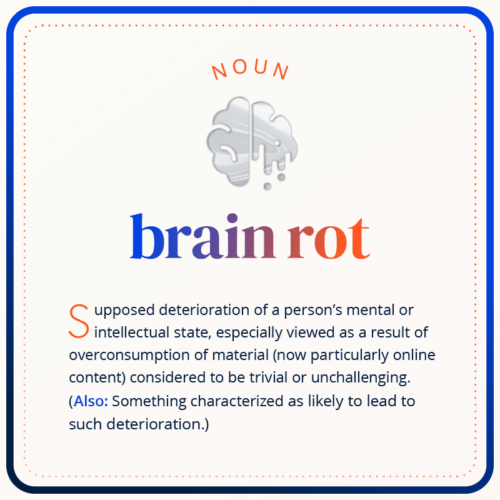
Small wonder it beat out four other words, all chosen by in-house language experts, and then voted on by more than 37,000 people. Even its classification as a word, when it’s obviously two words, speaks to brain rot as a now systemic cultural condition.
All language snobbery aside, OUP’s definition is no lie. So if you’re reading THIS, meaning my blog and an occasional book, you’re probably okay. But social media only? Your brain is so rotten I can smell it through the servers. In lieu of a vaccine, maybe RFK can prescribe a natural treatment.
Tell mom it’s okay to be a brat now
Experts and staff over at Collins Dictionary picked brat as 2024’s WOTY over nine other wannabes. Though for five centuries brat has meant a spoiled and badly behaved child, a Charli XCX album of the same name gave it new life last summer.
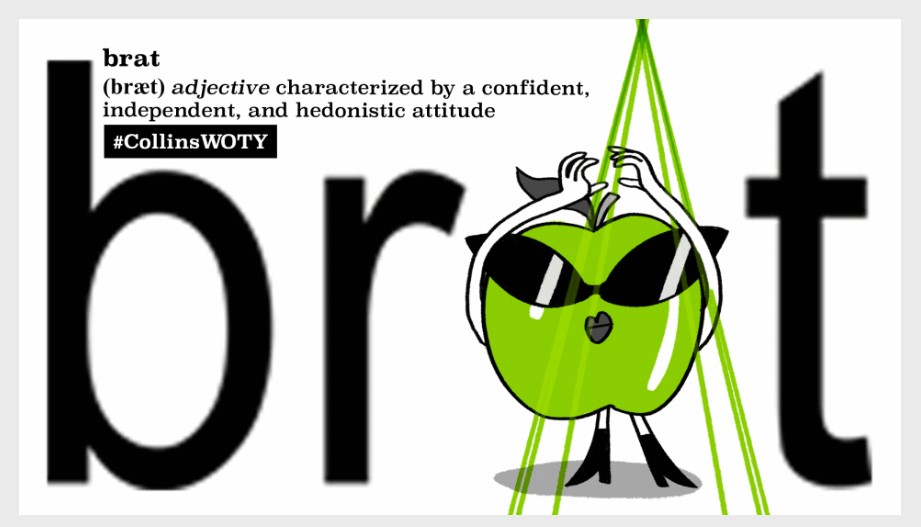
I don’t even know who “Charli” is, but then, I’m one of the ever-dwindling and increasingly senile cusp-boomers.
“Brat has become one of the most talked about words of 2024,” according to Collins. “More than a hugely successful album, brat is a cultural phenomenon that has resonated with people globally, and ‘brat summer’ established itself as an aesthetic and a way of life.”
Hmmm… Still sounds like a spoiled and badly behaved child to me. My mom (rest her soul) would make no allowances.
Demure is as demure does
Lexicographers over at Dictionary.com chose demure out of a shortlist of 10 because it experienced a nearly 1,200-percent increase in usage in digital web media alone. The word has been around since the 14th century, describing someone who is reserved, quiet or modest.
But usage expanded in 2024 to describe “a refined, sophisticated appearance or behavior in public.” The difference–if you can call it that–is because we’re at a time when employees are increasingly returning to group workplaces after remote work during the pandemic.
Okaaaayy… That sounds like mostly the same demure to me. Could the watershed be that the return-to-the-office trend has a social-media poster child?
Sure enough, demure‘s meteoric rise is attributed to TikToker Jools Lebron’s popularization of the phrase “very demure, very mindful.” Just another medieval adjective until the week of Aug. 18, 2024, when Jools’ posts hit paydirt and demure exploded.
Well, the exploded part is apparent. But my take? Not so demure. And it’s on TikTok, so it automatically qualifies as brainrot, IMO. (I can’t resist mentioning at this point that brainrot was also one of Dictionary.com’s finalists, but it had the wherewithal to list it as one word.)
Go forth & manifest, but be advised
This is one of two WOTYs in our list that comes with a disclaimer. Manifest, from the Latin manifestus, meaning evident or obvious, has lately come to reference what psychology has long called “magical thinking.” It was looked up almost 130,000 times on the Cambridge Dictionary website, making it one of the most-viewed words of 2024.
The word jumped from use in the self-help community and on social media to wide use across mainstream media and beyond, as celebrities spoke of manifesting their success. It’s come to be used in the sense of to imagine achieving something you want in the belief that doing so will make it more likely to happen.
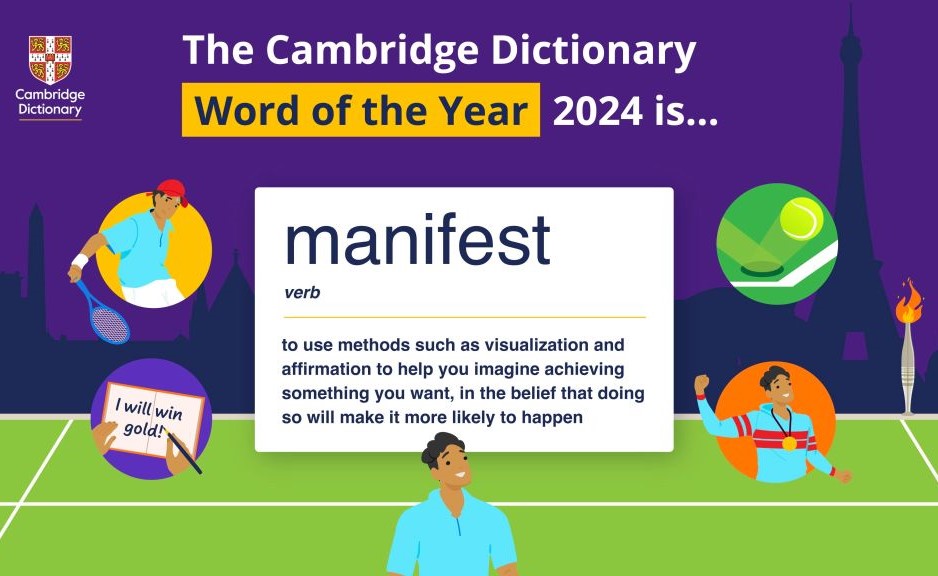
“There is good research on the value of positive thinking, self- affirmation, and goal-setting,” said Dr. Sander van der Linden, University of Cambridge professor of social psychology. “Believing in yourself, bringing a positive attitude, setting realistic goals, and putting in the effort pays off because people are enacting change in the real world.”
But that’s different from manifesting. “Manifesting gained tremendous popularity during the pandemic on TikTok with billions of views, including the popular 3-6-9 method which calls for writing down your wishes three times in the morning, six times in the afternoon and nine times before bed,” van der Linden continues. “This procedure promotes obsessive and compulsive behaviour with no discernible benefits.”
What comes to my mind is the 19th century policy of “manifest destiny,” learned in high school U. S. History: our country’s “divinely ordained” right to expand its borders to the Pacific Ocean and beyond. We considered it achieved after booting the Spanish out of Texas and California. But the idea is having a new moment, making me wonder if the current resident of 1600 Pennsylvania Ave. is using the 3-6-9 method to manifest annexation of Greenland and Canada and repatriation of the Panama Canal.
OCD, magical thinking, manifesting–it all fits with what I’ve read on Truth Social. I just hope Greenland, Canada and Panama can rest easier knowing there’s no scientific basis to it.
Polarization rates my cold shoulder
This is a word whose time has passed. It’s old hat. Passe. Polarization should have been the WOTY for 2015 when blue and red was born on election night (thank you, Tom Brokaw). It quickly found its way onto social media where it’s been the primary reason for unfriending ever since.
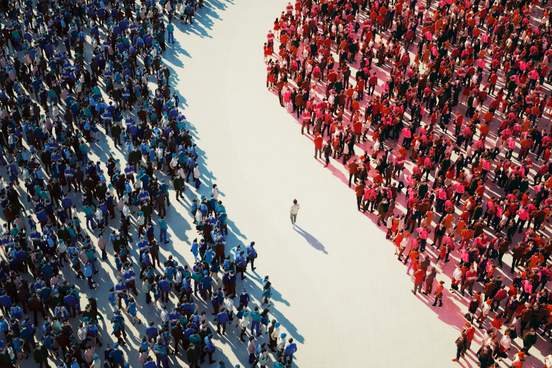
The word comes from the Latin polaris, which describes the earth’s poles and has been in use since the early 1800s in reference to light waves vibrating in a definite pattern.
Merriam-Webster chose it for its WOTY because of its frequent use in 2024 by politicians and thought leaders debating issues in the presidential campaign. They define it as “division into two sharply distinct opposites; especially, a state in which the opinions, beliefs, or interests of a group or society no longer range along a continuum but become concentrated at opposing extremes.”
You can say that again! Ten years and three presidential elections later, it remains the only thing republicans and democrats agree on. It’s just that it’s no longer news.
Who’s rawdogging it now?
After voting by more than 300 members attending the American Linguistic Society’s annual meeting, the American Dialect Society named the verb rawdog as its WOTY. ADS is the mother of all WOTYs (started it all in 1990) and yet its 2024 choice is a relatively new word whose meaning expanded from smutty to not-so-much but still risky and definitely unpleasant.
Rawdog first appeared in the early 2000s as a slang term for having sex without a condom but has officially crossed over into mainstream use to mean undertaking any activity without usual protection, preparation or comfort.
It refers to “engagement in any activity without the typical preparation or in stone-cold sobriety,” explains the ADS New Words Committee’s data czar (yes, a real committee and a real title). “In 2024 folks rawdogged flights, family dinners, and final exams.”
Flight rawdogging is where the most obvious risks come in. The trend has been loosely credited to the Apple TV+ series “Hijacked,” in which a character must endure a seven-hour flight from Dubai to London without amenities because his airbus has been hijacked. This inspired viewers to have real-life flight rawdog competitions and boast about their records on social media, which caused experts to warn of dehydration from lack of water and deep-vein thrombosis from lack of movement.
All that aside, this just might be the most prescient of all the WOTYs, as Trump rawdogs the office of president forward. Or backwards. Or both simultaneously. Maybe someone will come up with a word for THAT and we’ll see it in next year’s lists. Meanwhile, just keep him in that chair watching cable news and doomscrolling social media, feed him Cokes and Big Macs, and let nature take its course.
Enshittification strikes again
This WOTY has to be my favorite, and it’s even newer than rawdog. Though it’s certainly comprised of some familiar syllables, it has no prior or additional meanings since journalist Cory Doctorow first used it in 2022 to explain why people were leaving Facebook and Twitter.
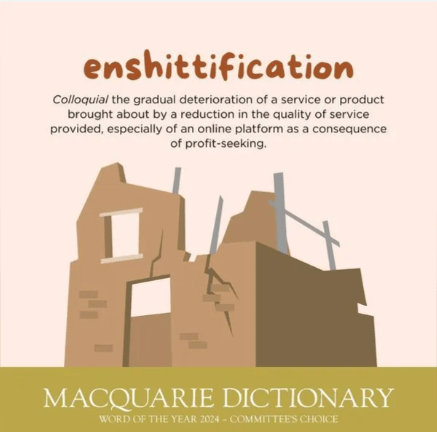
“My early writings on enshittification focused on its symptoms, the way platforms decay,” Doctorow wrote on his blog Locus. “The progression of the disease looks like this: First, companies are good to their users. Once users are lured in and have been locked down, companies maltreat those users in order to shift value to business customers, the people who pay the platform’s bills. Once those business users are locked in, the platform starts to turn the screws on them, too – extracting more and more of the value generated by end-users and business customers until all that remains is the meanest residue, the least amount of value that can keep everyone locked into the platform.”
Enshittification first became the ADS WOTY in 2023. Then Macquarie, the official dictionary of Aussie English, followed suit in 2024. Maybe with Australia being down under and all and having flipflopped seasons, it didn’t get the memo. But whatever the reason, it’s a WOTY worth repeating, and I’m gratified to be able to include it in this post.
Any system can become enshittified, but I am forever complaining about the enshittification of Facebook. It started out as an easy and fun (Yes! Remember?) way to connect with friends and relatives. But now it’s hard to even FIND those posts because of all the memes, ads, clickbait, influencer content, political and religious crap, foreign bots, addictive garble and devious algorithms. Not to mention the hate speech, misinformation, distortion and outright lies since its enshittified CEO gave up on fact-checking so he could cozy up to Elon and Don.
I’m tickled to finally have one word to describe what I’ve been feeling. For those of you squeamish about its core syllable or those who overuse it and need a synonym, there’s crapification, which may well appear in the next round of WOTYs.






 & {sometimes} WHY
Leave a comment