
Political conspiracies are always hot properties for Hollywood. But in the 1960s and early 70s they were on fire, what with the Cuban Missile Crisis, the Cold War with Russia, and the assassinations of Jack and Bobby Kennedy, Martin Luther King and Malcolm X. In fact, Fletcher Knebel, co-author of Seven Days in May, the movie version of which is one of this week’s classic picks, published another political thriller novel that seems ripped from TODAY’s headlines, though it’s been around since 1965.
It was called Night of Camp David, and read for yourself if anything sounds familiar in its plot summary:
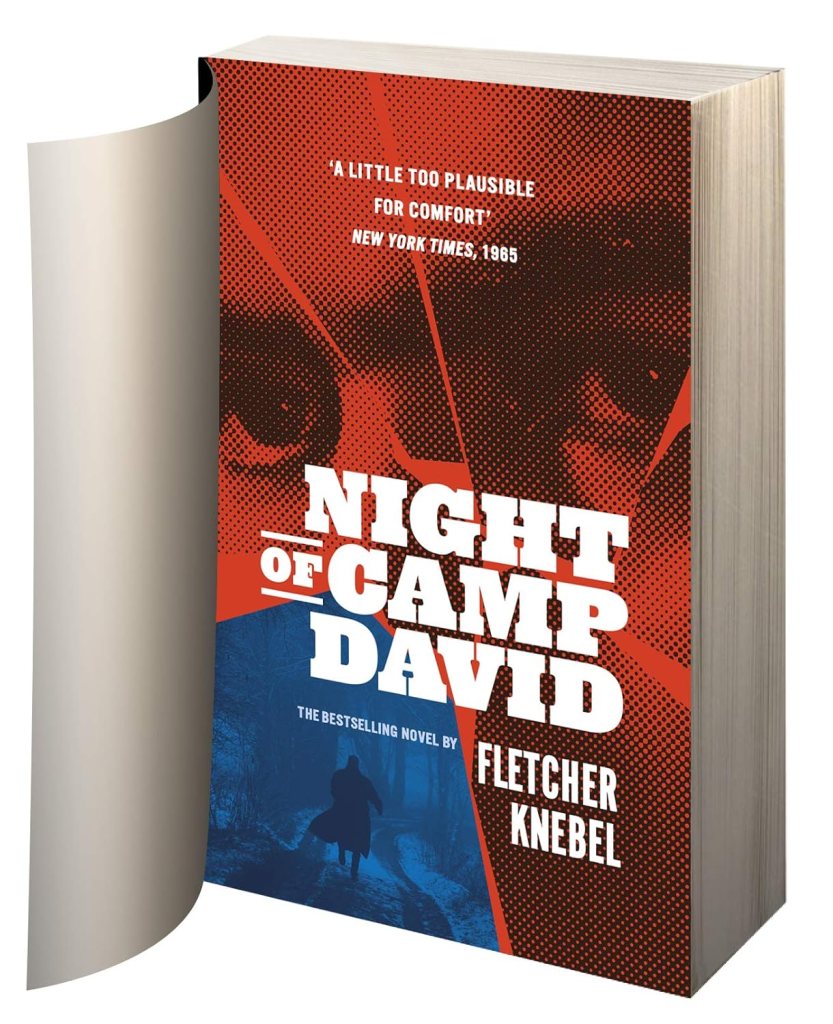
An aging president of the United States and a young midwestern senator chosen as his second-term running mate have a late-night discussion in which the elder statesman shares a plan to make America greater than it’s ever been. He suggests annexing–are you ready for it?–Canada. He then throws in Scandinavia because of its gene pool–Norway, Sweden, Finland and Denmark–“to bring us all the character and the discipline we so sadly lack.”
Other NATO members would be frozen out–particularly Great Britain, France and Germany, who the president believes are has-beens. Military force would be used only if necessary. “There are other kinds of pressure,” the fictional president continues, “trade duties and barriers, financial measures, economic sanctions if you will.” In the short term, however, the president’s first move would be to meet with Russia and propose a nuclear alliance against China.
The running-mate believes the president is insane and tries to alert other members of government before such a summit with the Kremlin can take place.
Knebel’s Night of Camp David novel never made it to the big screen, despite good reviews and more than four months on the New York Times best-seller list. Perhaps Hollywood thought the idea was just too much of a stretch for movie audiences then. But as of April 15, 2021, Paul Greengrass (director of three Bourne movies) was set to produce and direct just such a film adaptation for Universal Pictures.
Until that debuts (no information available on its progress), enjoy these three classics, all of which involve threats to the U. S. presidency.
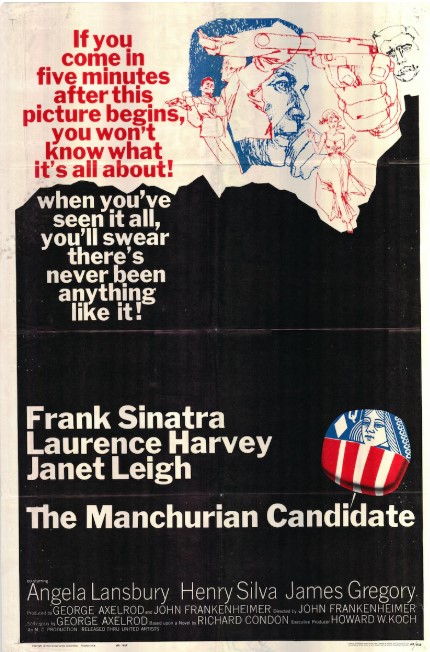
The Manchurian Candidate
RELEASE DATE: 1962 DIRECTOR: John Frankenheimer STUDIO: MGM HEADLINERS: Frank Sinatra, Laurence Harvey, Angela Lansbury, Janet Leigh RUN TIME: 2 hours, 6 minutes FILMED IN: Black & White IMDb RANK: 7.9
SYNOPSIS: A decorated American POW in the Korean War is brainwashed to become the unwitting assassin for an international Communist conspiracy led by his mother and stepfather, a sitting U. S. Senator.
NOTES: Based on the 1959 novel by Richard Condon. Sinatra broke his little finger in a fight scene, couldn’t bandage as long as filming continued. It never healed properly and caused him difficulties the rest of his life. Sinatra notoriously gave his best performances on first takes. There’s a slightly out-of-focus scene in the movie that was his first take. It was reshot, but Frankenheimer decided to use the first take anyway and was later praised for the “distortion” it added. Although Lansbury played Harvey’s mother in the film, she was, in reality, only three years older. The book portrayed her character as having been sexually abused by her father, which led to her using sex to control her son. The movie reduced the encounter to a VERY creepy kiss she bestows on him that ends up being much more effective, in my opinion. The brainwashing sequence was filmed three times in its entirety against three different sets constructed so the camera could turn completely around in each. The parts were then edited together to convey the shifting perspectives of different characters in what was a mesmerizing work of filmography. A 2004 remake stars Denzel Washington, Liev Schreiber and Meryl Streep in the title roles.
LINKS: Trailer | Full film free | Full film rent/buy
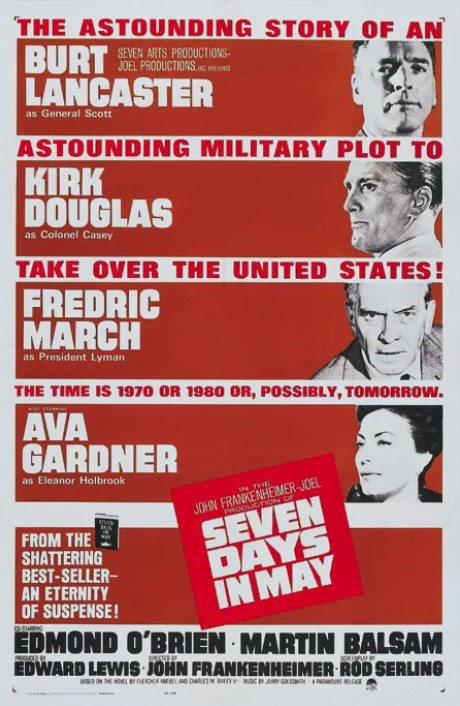
Seven Days in May
RELEASE DATE: 1964 DIRECTOR: John Frankenheimer STUDIO: Paramount HEADLINERS: Burt Lancaster, Kirk Douglas, Fredric March, Ava Gardner, Edmund O’Brien, Martin Balsam RUN TIME: 1 hour, 58 minutes FILMED IN: Black & White IMDb RANK: 7.8
SYNOPSIS: U. S. military leaders plot to overthrow the President because he supports a nuclear disarmament treaty and they fear a Soviet sneak attack.
NOTES: The film is set several years in the future–1970–and sets were designed to look futuristic. Screenplay written by Rod Serling and based on the 1962 novel of the same name by political journalists Fletcher Knebel and Charles W. Bailey II. Lancaster’s character of Gen. James Mattoon Scott was believed to have been inspired by both Gen. Curtis LeMay and Gen. Edwin Walker. According to director Frankenheimer, the project received encouragement and assistance from President Kennedy. In spite of Defense Department opposition, Kennedy arranged to visit his family compound in Hyannis Port for a weekend when the film needed to shoot outside the White House. The Pentagon and Navy weren’t as accommodating, so Frankenheimer employed “guerilla filmmaking tactics” by filming a shot of Douglas entering the Pentagon from a parked car and sending Balsam ferrying to the supercarrier USS Kitty Hawk in San Diego without prior permission.
LINKS: Trailer | Full film free | Full film rent/buy
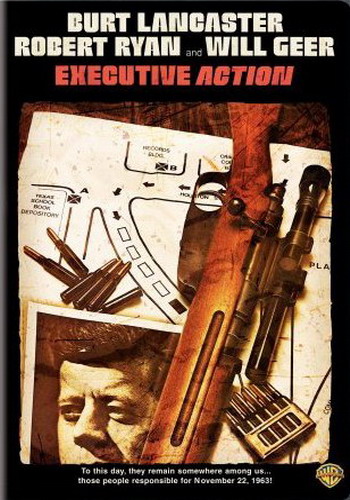
Executive Action
RELEASE DATE: 1973 DIRECTOR: David Miller STUDIO: Warner Brothers HEADLINERS: Burt Lancaster, Robert Ryan, Will Geer RUN TIME: 1 hour, 31 minutes FILMED IN: Color IMDb RANK: 6.7
SYNOPSIS: A fictional account of how rogue intelligence agents, right-wing politicians, greedy capitalists and freelance assassins could have plotted and carried out the assassination of President John F. Kennedy. Told from the standpoint of the conspirators as they work toward their goal in a cold and calculated manner.
NOTES: Mark Lane and Donald Freed’s original script implicated the CIA in the plot, Dalton Trumbo’s revisions actually absolved the CIA. When Lane and Freed tried to intervene, they were barred from the set. The film was released on the 10th anniversary of the JFK assassination. It was the final film Robert Ryan made, and he died of cancer four months before its release. Steve Jaffe, an investigator who had worked with New Orleans District Attorney Jim Garrison, was the film’s technical consultant and supervising producer, which begs the viewer to follow up this movie with Kevin Kostner’s 1991 film JFK for comparison.
LINKS: Trailer | Full film free | Full film rent/buy
Please note this post contains affiliate links.
Use the comments to share…
- If you have seen one of these movies and what you thought of it
- If you have a favorite movie in the “conspiracy” genre
You might also enjoy Classic Movie Buzz…
- #1: The Russians Are Coming! The Russians Are Coming!, Passport to Pimlico, The Children’s Hour
- #2: Lawrence of Arabia, Serious Charge, Mandy
- #3: An App to Track Your Classic Movie Finds plus Across the Bridge, The Mark and Back from Eternity
- #4: Gaslight, Scream of Fear (Taste of Fear), So Long at the Fair
- #5: An App to Cast Movies from Phone to TV plus How to Steal a Million, Gambit and Who’s Minding the Mint?
- #6: Take a Winter Vacation on the Cheap by Streaming 3 Movies Set in Sunny Italy: Summer Affair, Three Coins in the Fountain, Light in the Piazza
- #7: World War II Down-Under Movies: Battle Cry, A Town Like Alice, Until They Sail









 & {sometimes} WHY
Leave a comment