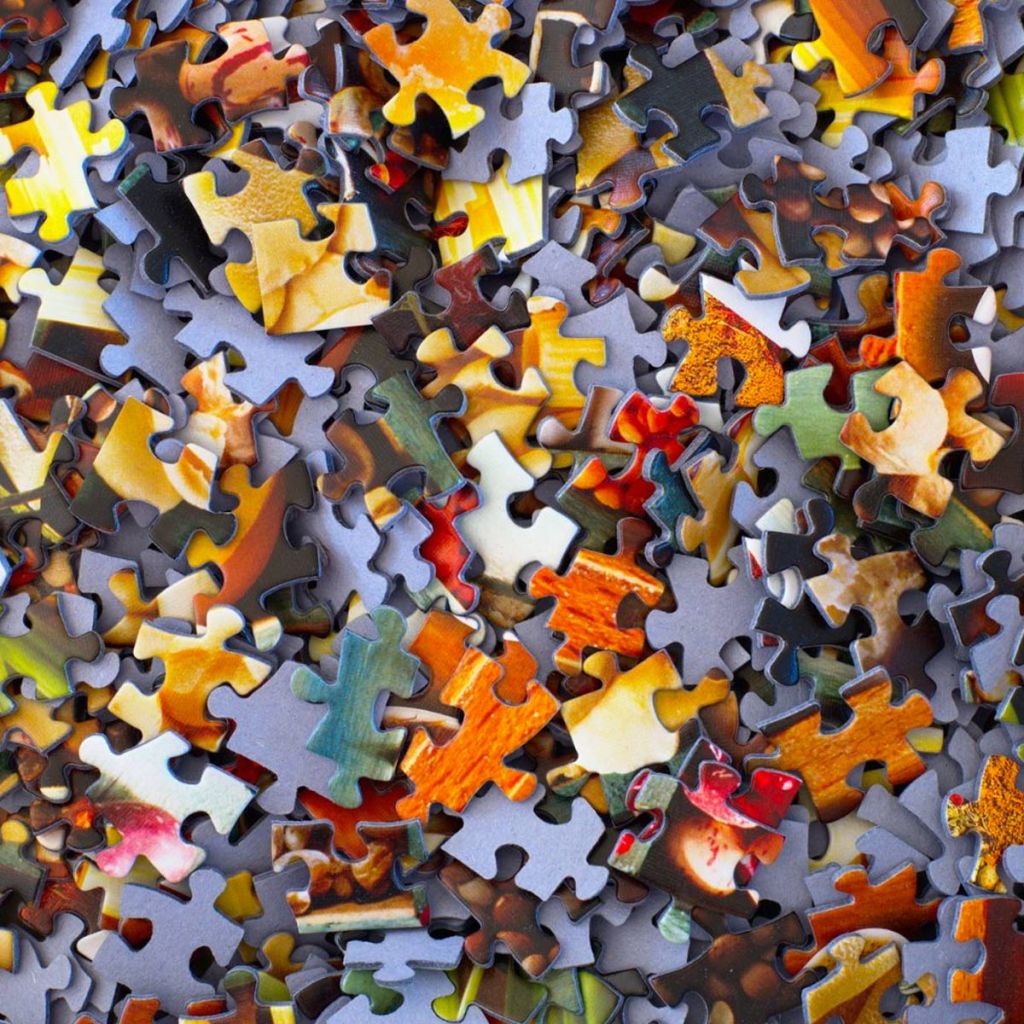
If you’re over 50, you probably get tons of ads on your phone for this and that puzzle to stave off dementia. My least favorite one is the AI-generated “neurologist” who doesn’t look old enough to have graduated college, let alone finished a neurology residency. (His over-tucked eyes look like botched plastic surgery and give me the creeps.) But whatever his “experience,” he instructs ALL of his older patients to play a certain game to “prevent dementia.”
Or so “he” says. Doesn’t anyone regulate phone ads? That’s a government agency we SHOULD add.
Regardless, what better day is there than today, National Puzzle Day, to consider whether doing puzzles can actually prevent dementia? The answer to that question is a puzzle itself; research to date says–ha-ha–that it’s a puzzle and more research is needed. Stimulating the brain with puzzles and games MAY delay the onset of dementia by a couple years, experts conjecture, because solving puzzles does seem to create more synapses–connections–in the brain. And if you have more synapses, then when you lose some through aging it’s not as noticeable and you get another coherent year or two.
Even so, like exercising your muscles, exercising your brain is a good thing. It’s way more fun than pushups, and carries a dopamine hit to boot! Those are facts.
I’m a dissectologist from waaay back
That’s a fancy name for a puzzle lover, and one of my fondest memories growing up involved working on jigsaw puzzles with my dad. He would pick out a scenic photographic puzzle to buy, always at least 1,000 pieces (anything less was just too easy!), set up the card table in a corner of the living room, and sit for hours.

Neither of my brothers or my mom seemed much interested in the endeavor, so when I pulled up my chair alongside dad’s I pretty much had him all to myself–a rarity. We didn’t talk a lot, but we helped each other out, and he showed me ways to approach the puzzle.
Of course, you generally start a jigsaw by sorting out all the border pieces and building the frame. Then, it makes sense to pick an area you want to begin to build–sky, water, forest, buildings, flowers, a roadway or path–and work to expand it until you can join it to an edge or to other sections. Working on divisions between different areas–like horizon lines or water and land–is a good strategy as well. Once you get the line, you can fill in on either side.
As we worked, he’d find pieces for areas I was working and pass them along, and I’d do the same for him. We both got a special kick when a section one of us was doing joined to a section the other was constructing.
It wasn’t long before dad consulted me about which puzzle to buy because he knew we’d work on it together. We both wanted a picture we enjoyed looking at all those days it took us to complete, as well as one with areas we thought would challenge us.
I can’t ever remember putting the same puzzle together twice, and eventually the boxes got shipped off to Goodwill or to the church tag sale. They were boxes full of love and fun that we passed on so they could keep on giving!
Ups & downs & ups of puzzle love
I continued doing jigsaw puzzles alongside dad when he was in assisted living. The common room there was full of tables and chairs and several puzzles in some stage of solving. Still, we sometimes had a difficult time finding one we liked because most were 500 pieces and under–too easy for puzzle snobs like us!
As he got older, his benign tremor got worse and he had trouble handling smaller pieces, so we succumbed to the 500-piecers until eventually he couldn’t do them at all or no longer wanted to. It was tough on me to watch him lose interest in things he always loved.
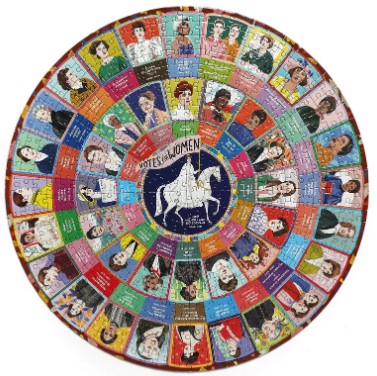
I’ve worked only one cardboard puzzle since dad passed away in 2013. It was a circular “Votes for Women” puzzle my daughter gave me for Mother’s Day one year. My husband doesn’t share my puzzle love, and doing it alone wasn’t as much fun as when dad and I worked together. Plus, it’s hard to find photographic puzzles of scenery these days.
I do have a puzzle app on my phone I dip into occasionally. The variety is endless–lots of scenic photos–and the complexity is adjustable. But when set above 100 pieces it’s hard to see and manipulate on a smartphone for these 68-year-old eyes and fingers. (I have a tremor too.)
Luckily, there are lots more kinds of electronic puzzles out there. My daily laptop puzzle run includes the New York Times, the Washington Post and The Atlantic. I read these publications anyway, and sometimes puzzle answers are found in issues. I like the word puzzles most–crosswords, Connections, Wordle, Letterbox and more–and sometimes delve into the archives.

On my phone, I’m heavily into a hidden object game called “June’s Journey” that I like to think improves my observational skills. June is a detective, and like her, players have to find clues, as well as a number of objects hidden in plain sight in scenes. There’s a great story line, rich scenes and several side games to work on that keep things interesting.
Puzzles are everywhere
If you visit Planet Word, a free museum of language arts in Washington, DC, you can check out a themed puzzle to enhance your museum experience (anytime, not just on Puzzle Day). Search for gold dubloons, help Zeus solve problems on Mt. Everest, search for escaped honeybees, explore the Hawaiian language to find a lost song, search for secrets in songs of yesteryear, follow the runes to Valhalla, and more.
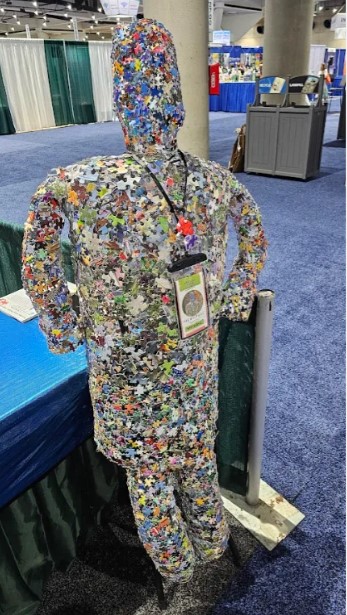
A little closer to home, check with your local library to see if it sponsors any National Puzzle Day events. Common events might include competitions, puzzle hunts, puzzle-making, puzzle swaps, and puzzle art like the puzzle man shown at right. It’s another great way to use those jigsaws you’ve already put together!
Jodi Jill, National Puzzle Day founder, also has lots of great ideas and activities for celebrating on her website and instagram. And don’t forget to post YOUR puzzle day activities to #puzzleday.
As for me on National Puzzle Day…
I’ll be dissectologizing again.
While writing this post over the weekend, I found myself missing those days with dad and ordered a 1,000-piece cardboard jigsaw of Niagara Falls. It arrived yesterday, and I’m going to spend today working on it. I need a break from the news.

I chose this puzzle because of another fun memory associated with my dad. By the time I was born he was big into his movie camera, and watching his home movies against the backdrop of a sheet suspended on a wall of our living room is embedded in my neuro-channels.
I’ll never forget movies of Niagara Falls he recorded before I was born because he would always run the projector backwards for fun and make the water in the falls go up. The first time my Grandmother Clark saw this, she thought it was for real and asked, deadpan serious, “How do they make the water do that?” My brothers and I laughed until our bellies hurt.
I guess I could call that “Grandma’s Puzzle.” After we all were done laughing, we put her out of her misery and told her, and she laughed, too. Like mother like son, like father, like daughter. Connect the pieces and generate some synapses.
You might also enjoy…
- “Can Puzzles and Games Prevent Dementia?” by Dana G. Smith and Katie Mogg in The New York Times
- “Can a Daily Crossword Puzzle Prevent Cognitive Decline?” by Teddy Amenabar in The Washington Post
- “The Myth of the Brain Game” by Venkat Srinivasan in The Atlantic







 & {sometimes} WHY
Leave a comment