The encounter was a simple one. I had to get blood drawn for some annual tests. One test required fasting, and I hit the clinic not long after it opened so I could go home and have my coffee and breakfast. But other people had the same idea. The waiting room was a logjam, no customer service reps were at any of the person-to-person check-in cubicles, and even the automated check-in terminals were in use.
I asked the woman at the information desk if she could check me in, and she replied she could but that a customer service rep had just stepped up to one of the cubicles. I looked up and saw a young black man with a warm smile aimed my way enter a cubicle and pull out his chair. I thanked the information desk clerk and walked toward him.
Things in common
As I sat down, the CSR, whose name badge read Marcus, laid a book down on the desk. It was a thick hardback with a black and gold dustcover, titled Rome and Persia.

“Looks like you have some heavy reading ahead.”
Marcus smiled. “Thank you,” he replied. I assume he thanked me because my manner suggested he was indeed capable of heavy reading.
“I’m a Roman history buff, too,” I added.
His whole face lit up with interest. “It’s just so fascinating, isn’t it? I’m interested in Persia, too.”
“Yes, it is fascinating. It’s not often I meet someone who shares that interest. I start talking about Rome sometimes and people’s eyes roll back in their heads.”
“I’ve had the same experience,” he laughed. “I haven’t been able to get too deep into this book yet, so I try to keep it with me, just in case.”
“That’s what I do, too, to take advantage of any time I can find to read.”
He nodded contentedly. We had connected over two shared interests: Roman history and reading.
Checking-in
Our conversation went back and forth with tidbits about what made Rome so fascinating while he checked me in. I hadn’t been to this facility in a year, so Marcus had to scan in my insurance card and picture ID. I had tests requested by two different doctors and that required some extra keying-in. And then the scanner didn’t pick up my insurance numbers correctly, which required rescanning.
Long story short: checking-in took a little longer than normal and gave us time to chat further. At some point Marcus made the reference, “since I came to the US.” He then moved on to whatever part of checking-in we had reached.
He had no discernible accent, so I was curious and backtracked. “Where did you come here from?”
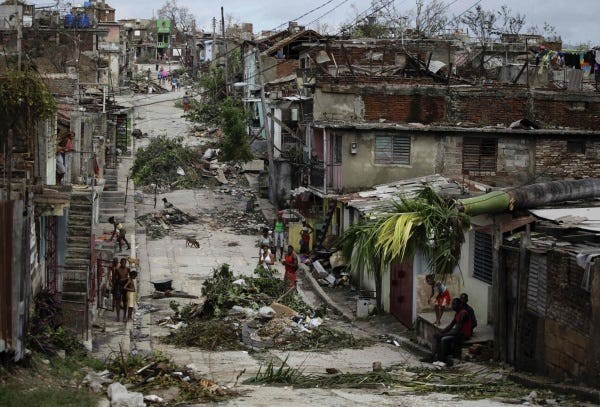
“Haiti,” he replied. “We left there in 2012.” I didn’t want to act too familiar–he was, after all, working–so I didn’t ask why, but that was the year Hurricane Sandy hit Haiti. Only two years before the country had experienced a major earthquake. And in 2016 Hurricane Matthew offered wreaked even more havoc.
“Did you come directly to Indiana?”
“No,” he said. “We came first to Kennesaw, Georgia, and I really liked it there. Then we went to Stamford, Connecticut.”
“Brrrr, cold,” I said, doing a mock shiver. My niece and her family had lived there.
He chuckled. “I didn’t really like it there. It was my mother, my sister and I, and while we were there we were able to bring my father over too. Then we all came here.”
I asked if he liked it here, and he said he did. “There weren’t many Haitians here when I first came, but now there are quite a few.”
“Same with Sikhs. Most of my neighbors are Sikhs. Their population in the whole county is growing.”
The importance of names
At this point he needed to confirm the names of the doctors who ordered my tests. One has a first name of Mary but goes by the nickname of her middle name, Cathy. This took some clarifying, for the records. I said I remembered childhood friends who were Catholic who did this, and it was always a puzzle to me.
He chuckled and said he had to alter his name when he came here because people couldn’t pronounce it. “But I like Marcus okay. It’s close enough.” It is, after all, a good Roman name. Wish I’d thought to say that.
“I know my Sikh neighbors as Shev and Nick,” I said. “But one time I opened Shev’s mailbox by mistake–it’s right next to mine–and I saw his full name on a piece of mail, and I was overwhelmed trying to think how to pronounce it. I felt like I should know or should learn. Names are so important.”
He laughed again. “It’s just easier this way,” he said. “Besides, my favorite name is daddy, and that’s the one I hear most often.” It was if a shaft of sun made a path across his face.
“I bet.”
Thankful for immigrants
“Before I got this job,” Marcus continued, “I sold used cars. We would get buyers who didn’t speak English, and I could translate. I liked being able to help, and the money was good. But the hours were long, and I couldn’t spend as much time with my family.”

“Family is so obviously a priority with my Sikh neighbors, too, and add so much to the beauty of our neighborhood,” I elaborated. “I love that they put up outdoor lights in October for Diwali and leave them up until after New Years. It’s amazing to drive down our illuminated street. They love fireworks, too, so we never have to go anywhere on the Fourth of July. We can see the best ones from our patio.”
By that time, I was checked in. Marcus gave me some brief instructions to pass on to the tech who drew my blood, then pointed me to the waiting room and apologized for the wait.
“No worries,” I said. “It’s been a pleasure chatting with you.”
“Me as well,” he replied.
“Enjoy that book.”
He nodded that he would. “Thank you. Have a good day.”
I will now, that’s for sure.
What just happened here?
I moved down the hallway toward the waiting room and read on the electronic board that I was in for almost a half-hour wait. I didn’t mind, though, and the reason was Marcus.
How I wish I’d met him in circumstances where we could have talked longer about Rome, about Persia, about his immigrant experience, about what it was like being separated from his father. About whether they left before or after the hurricane? About what the earthquake was like? About how he met his wife and about his children? Girl or boy? How many? How old?
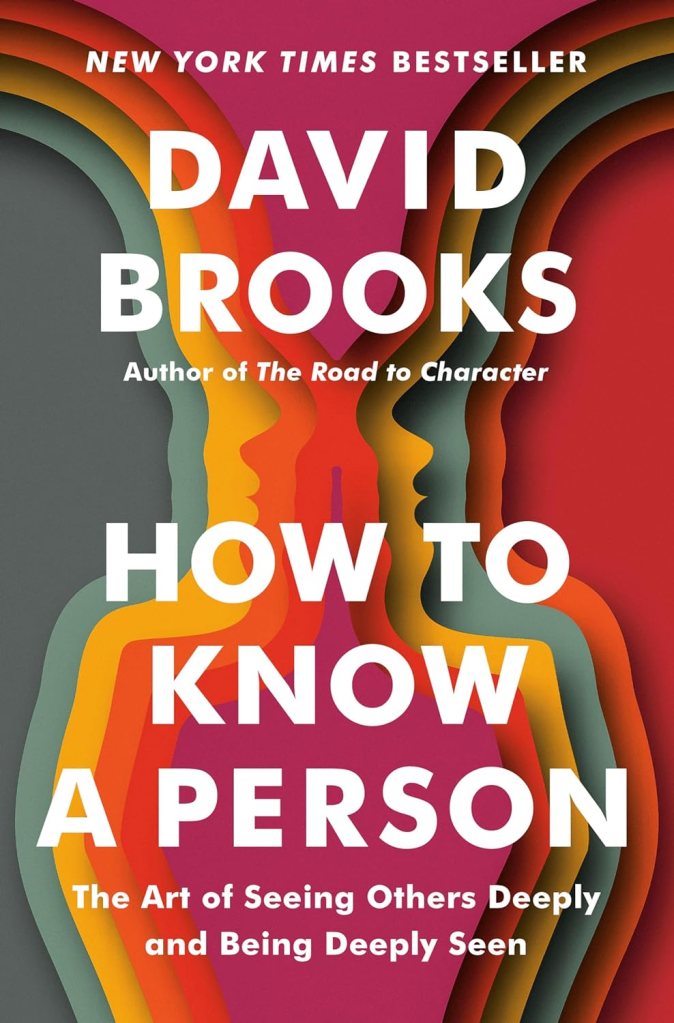
David Brooks writes in How to Know a Person…
In America, Europe, India, and many other places, we’re trying to build mass multicultural democracies, societies that contain people from diverse races and ethnicities, with different ideologies and backgrounds. To survive, pluralistic societies require citizens who can look across differences and show the kind of understanding that is a prerequisite of trust–who can say, at the very least, “I’m beginning to see you. Certainly, I will never fully experience the world as you experience it, but I’m beginning, a bit, to see the world through your eyes.”
He also quotes psychologist Diana Fosha, who writes, “The roots of resilience are to be found in the sense of being understood by and existing in the mind and heart of a loving, attuned, and self-possessed other.”
Brooks concludes, “In how you see me, I will learn to see myself.”
I’m always curious about other people. I hope Marcus felt seen by me. I know I felt seen by him. It was an informal encounter, but it warmed me for the duration of my wait.
Considerations over coffee
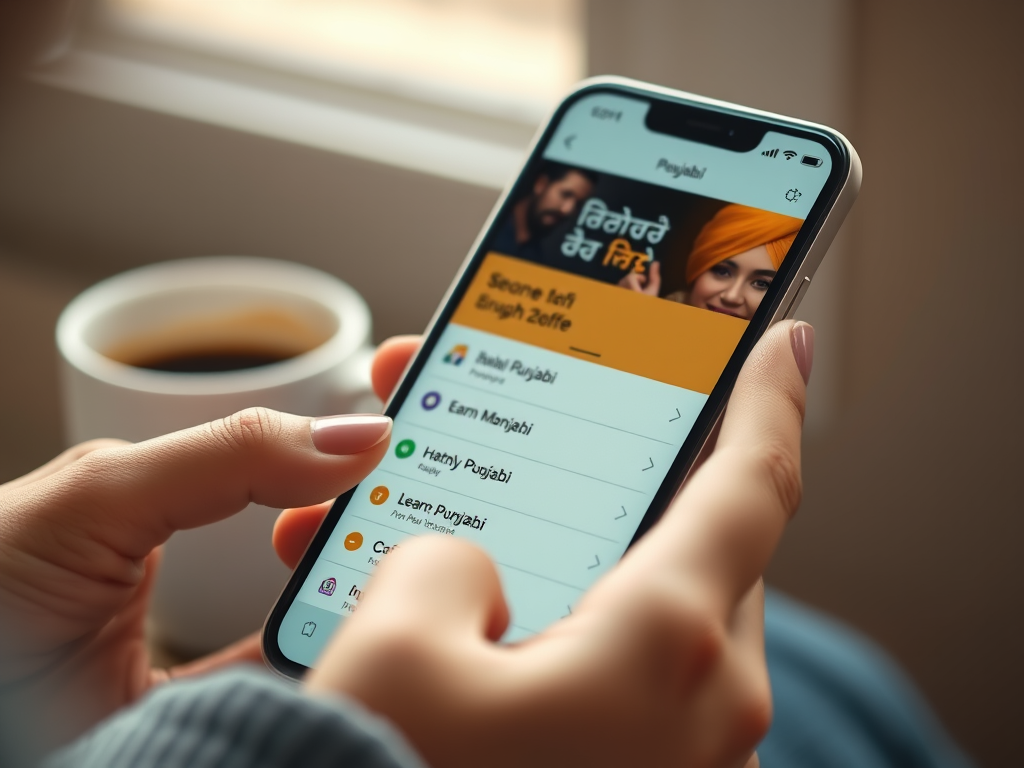
Finally home and having my coffee, I scrolled through my smartphone, exploring options for learning conversational Punjabi, which my Sikh neighbors speak. Although our male Sikh neighbors and their children are fluent in both English and their native language, many of the wives and grandparents are not. How isolating that must feel for them. What if I could chat with them? Would the back and forth help both of us learn about each other?
One neighbor who used to live next door had his mother living with them, and I would always see her out on their patio with their dog while I was sitting on my patio reading. We would wave and smile, but that was all we could do because of the language barrier.
One day another dog not on a leash came up to hers, barking, upsetting her dog, and jumping all over the place. She was trying to get herself and her dog into the house but the trespassing dog was making it impossible. I knew who the other dog belonged to, so I started walking toward its house and called it to come with me, which it did. I told its owner what happened, and they got it back on its leash.
The next day when I saw the grandmother, she smiled and waved as she always did, but added, “Thank you.” She said it haltingly, as if she’d only just learned it. But her smile was big.
“You are most welcome,” I replied and nodded. Don’t know if she understood the words, but surely my smile and nod conveyed my meaning.
Turns out there are many teachers of conversational Punjabi available from India through Zoom connections at prices ranging from $8 to $50 a session. YouTube also has plenty of videos and Amazon is full of instructional books and CDs.
It’s certainly something to think about because wouldn’t it be really great to talk to ALL of my neighbors–wives and elderly parents included? We see each other everyday with our eyes, but I’d like to meet through our hearts.








 & {sometimes} WHY
Leave a comment