You can show a grammar nerd new words and new ways of using old words, but you can’t always get her to go along with it. I know because I’m the prime example. In the 46 years since I graduated college with a degree in journalism and English, I’ve worked as either a writer/editor or as a teacher of writing. So the principles of written expression and of word formation and use are more like a religion to me than the actual religion in which mom and dad raised me.
In fact, when I dream about my writing, the setting for the dream is generally church. Words are my catechism. So for what it’s worth, here are some words and expressions tossed about with abandon today in a way that I find approaching sacrilege.
(Please be advised: This rant is one technique I’m using to work through my election grief. It’s not meant to offend.)
Weaponization, weaponize, weaponizing
This supposedly means using something deliberately to inflict harm on people. Its origin dates back to military jargon used during the Cold War (1947-1991). For example, adding nuclear capabilities to rockets to prepare for launching against an enemy was called weaponizing them.
These days, politicians, pundits and social influencers (there’s ANOTHER term I hate!) claim weaponization of everything from the courts to social media. If I threw a cherry tomato at my husband during lunch, it could be called the weaponization of salad. Now wouldn’t that be clever?
Argggghhh.
I’m not saying weaponization happens or doesn’t happen. I’m saying it’s lousy rhetoric– an irrelevant, made-up word, whether it finds its way into a dictionary or not.
When I took newswriting, we were told to AVOID using words in our writing that stacked on suffixes like -ize and -ation. Why? While they transform nouns into verbs, a lot of the meaning is lost in the process. Simple, colorful words that create distinct pictures are reduced to multisyllabic, bland mush.
Better to say, I pommeled my husband with cherry tomatoes.
See? Doesn’t that create a more vivid picture? (Sounds fun, too!)
Better to stick with precise nouns and colorful action verbs. When we pile suffixes onto the ends of words to reinvent them, we create a barrier between writer and reader, speaker and audience. We use the made-up word to hide behind, peeking out just to stun and stab but with no clear meaning or context.
Someone needs to weaponize the Oxford English Dictionary and beat the hell out of weaponization. Its end can’t come too soon.
Woke
As far as I’m concerned woke will ALWAYS be the past tense of the verb wake, meaning to end sleep. But it also has a long history of use in black and protest culture in reference to being watchful. Lately it’s been used more broadly to describe being politically conscious and aware, especially to racial prejudice and social injustice.
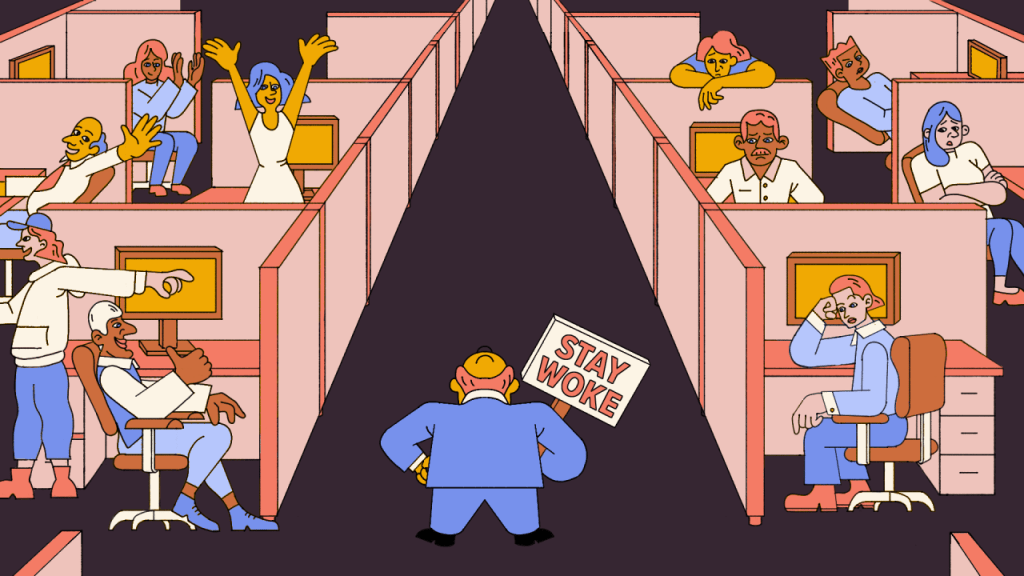
Those are all good things to aspire to, but I worry that since there’s no single agreed-upon definition of the term, how do we really know what people mean when they use it?For instance, conservatives invoke woke to mock ideas they find too liberal.
You could say conservatives have weaponized woke. Just don’t say it within earshot of me, okay? Like weaponize, woke used to mock is cowardly speech. We’d all be better off and maybe–just maybe–get something done if we spoke in specifics, not shorthand. The right’s derision of woke threatens to reduce it to a cliche, which is, I’m sure, their intent.
Word salad
This is one that’s made its way into everyday use only recently, even though it was first used in 1904 by German psychiatrists to describe the nonsensical speech of the mentally ill. A simpler term for this would be garble.
While word salad may seem a colorful label to resurrect for the rambling speech of some political candidates, it doesn’t really fit. The politician I have in mind doesn’t jumble random words and phrases. His are carefully chosen and highly charged, but his speech train is uncoupled. That is, he lacks continuity, context and transition. On purpose.
Better to call this a “word hash.” The word hash always reminds of that great scene from Prince of Tides when the wife gets back at her abusive husband who doesn’t like her “fancy” cooking by (unbeknownst to him) serving hash made with dog food.
And he laps it up, just like so many American voters. Because if you don’t really know what’s in there, you can swallow most anything.
Weave
For me, this one is right up there with word salad. Because, of course, the politician most often identified as using the word-salad technique (if it can be called a technique) in his speeches himself calls it a weave.

I think he thinks “The Weave” sounds sexy. But there’s no appeal to my ears in the delivery.
In standard usage, weave can be noun or verb and have several meanings. As a verb, it usually refers to interlacing long threads passing in one direction with others at a right angle to form a design, but it can also mean to make a complex story or pattern from a number of interconnected elements. As a noun, it is used to describe the pattern made, as in a tight or loose weave.
But the politician’s weave is not usually interconnected (or connected at all), and the pattern is indiscernible, more like the kind of weaving through traffic a drunk driver might do. It’s a concertina of unrelated statements lacking context, stacked on top of each other so that all compresses down to make an off-key squawk.
Here’s yet another metaphor: Call said politician’s weave “a porridge meant to deceive.” It has a nice ring to it anyway.
Gender neutral pronouns

I try to accept people however they choose to define themselves, I respect their right to pursue whatever identity they choose, and I don’t think they should be discriminated against. But I cannot do they/them/theirs instead of he/him/his or she/her/hers when referring to people not heterosexual.
It’s a complexity of modern life I find unnecessary and, moreover, grammatically incorrect. And the latter is my biggest objection, given that writing is my religion remember. Singular is singular and plural is plural, and never the twain shall meet, or overlap, as the case may be. It’s too much.
A friend of mine related a scene at a family get-together at which her nonbinary daughter tried to instruct a sister’s two sons under the age of four how to use gender-neutral pronouns. It caused a lot of confusion for the kids and raised way too many age-inappropriate questions. What is someone thinking trying something like this?
I’m sorry, but it’s too woke for me. Worse yet, it’s the weaponization of pronouns, if you’ll forgive me.
Early in my career, gender bias in writing was the big deal. What this meant was not to default to the pronoun he when making a generalized statement and not to use s/he, she/he, her/his and so on either because it’s clumsy. Instead, REWRITE to eliminate a gender-specific pronoun, like in the illustration below.

We can do the same when referring to people with fluid gender identities most of the time, I think. Notice how I wrote that second paragraph under this subheading. I didn’t call the nonbinary daughter a her or a they. I did use daughter, which is feminine, but she is still that. Errr…they is still that. Errr…
See what I mean? Too weird. Too awkward. Too much to trip over. Life should be more straightforward.
As for resumes and employee listings indicating preferred pronouns, well, that seems like too much information in a work environment. I don’t care who the people I meet choose to have sex with, and I’d rather not be smacked in the face with it. For most encounters, it isn’t relevant.
So what to do?
I try to remain conscious of respecting differences out there. I try not to be lazy in my speech or in my writing. I take the time to find alternatives to offending people while also not mutilating language.
And most of all, I try to hang on to my sense of humor, which I hope you also do as you read this. I mean well, and the whole rant thing did help ease my election grief. For today.







 & {sometimes} WHY
Leave a comment